Relying on an unverified supplier for critical mechanical components often leads to premature mechanical failures, unpredictable tension forces, and costly assembly line delays. To evaluate extension spring manufacturers effectively, OEM buyers must thoroughly verify their in-house CNC capabilities, engineering design support, metallurgical expertise, and strict batch-to-batch quality control systems.
Selecting an extension spring manufacturer requires far more than comparing unit prices. For OEM buyers and industrial companies, the supplier’s true engineering capability and production consistency directly influence the safety and reliability of the final assembled product. Partnering with a true manufacturer rather than a trading company ensures complete project lifecycle reliability, reducing product failures and unexpected development costs.
Table of Contents
- The Critical Difference: Real Manufacturers vs. Trading Companies
- Assessing Custom Extension Spring Design Capability
- Evaluating Material Selection and Performance Optimization
- Manufacturing Process and CNC Forming Capabilities
- Quality Control: Ensuring Batch Consistency for Custom Springs
- The Prototype to Mass Production Support Lifecycle.
- Industry-Specific Supplier Evaluation Criteria
1. The Critical Difference: Real Manufacturers vs. Trading Companies
The most common procurement risk B2B buyers face is unknowingly placing complex custom orders with trading companies rather than direct manufacturers. This creates a dangerous disconnect between the buyer’s engineering team and the actual production floor.
A reliable custom extension spring manufacturer operates its own in-house production facility equipped with CNC spring forming machinery, dedicated engineering teams, and transparent internal quality control systems.
When you evaluate extension spring manufacturers, your first step must be confirming direct manufacturing capability. Trading companies cannot provide immediate technical feedback on tolerances, nor can they rapidly adjust CNC coiling parameters if a prototype fails a load test. A true manufacturer controls the entire process in-house. This means they develop their own tooling and fixtures, maintain their own testing laboratories, and have direct oversight over raw material sourcing.
By working directly with a precision spring manufacturer, OEM buyers eliminate middleman markups, drastically reduce communication delays during the critical prototyping phase, and secure a long-term partner capable of handling repeat orders with identical consistency.
2. Assessing Custom Extension Spring Design Capability
Most mechanical failures in tension springs originate in the design phase, often because buyers submit drawings that lack manufacturability or specify incorrect tolerances for the available installation space.
A qualified supplier provides comprehensive extension spring design support by calculating optimal wire diameter, spring outer diameter, free length, initial tension, and working load requirements to prevent excessive stress.
Extension springs are uniquely complex because they are wound with initial tension—the internal force that holds the coils tightly together. A capable manufacturer does not simply feed a drawing into a machine; they review the design to ensure the specified initial tension is actually achievable with the requested wire diameter and material.
Optimizing Hook and Loop Structures
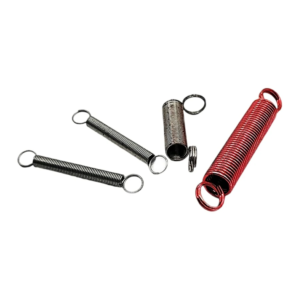
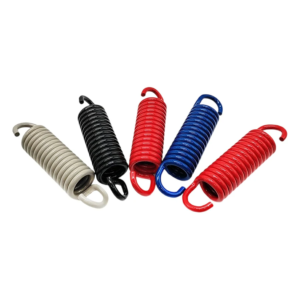
The most critical aspect of custom extension springs is the end configuration. The hook or loop is where load is transferred, making it the most common site of stress concentration and fatigue failure. Depending on your assembly requirements, your supplier must be capable of engineering various configurations, including open hooks, closed machine loops, extended hooks, and fully customized hook designs. A supplier with strong engineering support will analyze the bending radius of the hook; if it is too sharp, they will recommend design adjustments to mitigate bending and torsional stress, thereby preventing premature snapping under load.
Load Requirements and Dimensional Constraints
Engineers often face strict installation limitations. If a spring must fit into a highly restricted space but deliver a massive pulling force, the extension spring design must be flawlessly optimized. The manufacturer must calculate the spring index (the ratio of mean diameter to wire diameter) to ensure the coil can physically handle the extended length without yielding or permanently deforming.
3. Evaluating Material Selection and Performance Optimization
A spring’s lifecycle is entirely dependent on its metallurgical properties matching its operating environment. A drawing specifying generic “steel” is a major red flag that requires immediate supplier intervention.
Expert tension spring manufacturers recommend materials based on required tensile strength, fatigue requirements, temperature conditions, and corrosion resistance, ensuring the material matches the specific operating environment.
A professional supplier understands the deep relationship between material properties and final spring performance. They do not merely produce according to drawings; they actively optimize them.
For high-cycle applications where fatigue life is paramount, a knowledgeable supplier will steer buyers away from standard high-carbon steels and recommend alloy spring steels, such as chrome silicon or chrome vanadium, which offer superior resistance to dynamic shock and relaxation. Conversely, if the spring will operate in a caustic environment, they will evaluate various grades of stainless steel or specialized non-ferrous alloys. They must also balance these material choices against the manufacturing realities—knowing, for example, that stainless steel has different coiling characteristics and lower initial tension capabilities compared to standard music wire.
4. Manufacturing Process and CNC Forming Capabilities
The transition from a CAD model to a physical, high-performance component requires advanced machinery. Evaluating a supplier’s shop floor reveals their true capacity to handle OEM custom extension springs.
Before ordering, buyers must evaluate whether the manufacturer possesses complete production capability, including multi-axis CNC spring forming equipment, in-house tooling development, and comprehensive surface treatment support.
Traditional mechanical spring coilers are insufficient for modern, high-precision custom tension springs. Advanced CNC machinery allows for the precise digital control of pitch, initial tension, and complex hook geometries without the need for secondary manual bending operations. This automation is crucial for eliminating human error.
Furthermore, buyers should inquire about surface treatment capabilities. Whether the springs require zinc plating for rust prevention, e-coating for automotive applications, or shot peening to enhance fatigue life, the supplier must have strict processes in place to manage these treatments. Poorly managed electroplating, for instance, can introduce hydrogen embrittlement, causing a perfectly coiled spring to shatter instantly under its first load.
As a leading industrial spring manufacturer, Guangdong Hershey Spring Industrial Co., Ltd. (Hessp) provides advanced precision spring manufacturing capabilities, utilizing state-of-the-art CNC technology to support customized production across diverse industrial applications.
5. Quality Control: Ensuring Batch Consistency for Custom Springs
Approving a perfect first-article sample is useless if the subsequent mass production batch suffers from dimensional drift or wildly varying tension forces.
For custom springs, quality consistency is maintained by strictly controlling dimensional accuracy, batch stability, and spring force output through automated in-line measurement and comprehensive final inspection procedures.
B2B buyers are rightfully concerned about repeat order stability. A highly capable manufacturer proves their reliability by documenting their quality control systems. They should employ optical inspection systems on the coiling machines to eject out-of-tolerance parts instantly, and utilize precision load testers to verify the force profile of the spring at specific extended lengths.
Extension Spring Quality Evaluation Matrix
To properly audit a potential supplier’s quality control capabilities, OEM buyers should verify the following inspection parameters:
| Quality Parameter | Manufacturer Inspection Method | Impact on OEM Application | Acceptable Capability standard |
| Initial Tension | Precision Load Tester | Dictates the tactile feel and minimum starting force of the mechanism. | +/- 10% tolerance capability on initial load. |
| Dimensional Accuracy | Optical / Laser Micrometer | Ensures the spring fits into precise housing without binding. | CNC controlled to tight CPK standards. |
| Hook Angle & Position | Vision Inspection Systems | Critical for automated robotic assembly lines to prevent jamming. | Exact angular alignment verification. |
| Fatigue Life | Dynamic Cycle Testing Rig | Prevents field failures and costly automotive/industrial recalls. | Capable of in-house lifecycle simulation. |
| Material Traceability | Spectrometer & Material Certs | Guarantees metallurgy matches the engineering specifications. | Full ISO/IATF material documentation. |
6. The Prototype to Mass Production Support Lifecycle
A strong manufacturing partner manages risk throughout the entire lifecycle of a component, not just at the point of purchase.
A qualified OEM spring supplier seamlessly supports the full project cycle: from requirement review and design confirmation, through prototype production and testing feedback, to highly stable mass production.
This comprehensive support reduces the risk of discovering fundamental design flaws only after large-volume production begins. At Hessp, our standardized cooperation process is designed to lower buyer risk at every stage:
- Inquiry and Specification: Our engineering team conducts a deep-dive review of your application requirements, load conditions, and environmental factors.
- Design and Tooling: We optimize the CAD design for manufacturability, determining the exact CNC tooling required for the custom hooks and body diameter.
- Sample Trial: We produce a small batch of physical prototypes. This allows the buyer to test the tactile feel and force curve within their actual assembly.
- Testing Feedback: If the initial tension or extended length needs fine-tuning, adjustments are made quickly in-house.
- Mass Production and Delivery Support: Once validated, the design is locked into our CNC systems, ensuring that batch #100 is perfectly identical to the approved prototype.
7. Industry-Specific Supplier Evaluation Criteria
Different industrial sectors impose entirely different mechanical demands on extension springs. A supplier’s capability must align with your industry’s specific regulatory and performance standards.
Industry-specific evaluation focuses on stable mechanical performance for automotive components, high cycle durability for industrial machinery, and strict manufacturing traceability for medical devices.
Automotive Components
Automotive manufacturers require extension springs that deliver stable mechanical performance and a long service life. Applications such as locking mechanisms, seat adjustment systems, mechanical return components, and EV-related charging port doors require components that will survive continuous vibration and extreme temperature shifts. Automotive customers must prioritize suppliers with proven OEM production experience and stringent quality control frameworks (like IATF 16949 compliance).
Industrial Machinery
Industrial equipment often utilizes custom extension springs where repeated movement and heavy-duty reliability are critical. Typical requirements include high cycle performance, accurate force control, and customized dimensions to fit massive mechanical assemblies. A custom spring supplier with robust engineering support can help adapt spring designs to the specific leverage ratios and structural requirements of heavy equipment.
Electronics, Precision Equipment, and Medical Devices
Electronic products require highly compact spring components with incredibly small dimensions and highly stable spring force. Standard components rarely meet these strict packaging requirements. Medical equipment demands even more: components must offer absolute reliability, strict manufacturing consistency, material biocompatibility (often requiring surgical-grade stainless steel), and complete lot traceability to meet FDA or ISO 13485 requirements.
Conclusion
Evaluating extension spring manufacturers before placing an order is a critical risk-management process. By thoroughly assessing a supplier’s in-house CNC production capabilities, their ability to engineer custom hooks and precise initial tension, and their expertise in metallurgical selection, OEM buyers can confidently secure a reliable supply chain partner. A true manufacturer will guide your project from initial design optimization through rigorous prototype testing, ensuring absolute batch consistency during mass production. Choosing the right partner eliminates costly assembly delays, enhances your product’s mechanical lifecycle, and protects your brand’s reputation for quality.
Do you need to verify the manufacturability of your current extension spring design?
Send your extension spring requirements, CAD drawings, or load specifications to the engineering team at Guangdong Hershey Spring Industrial Co., Ltd. for a comprehensive manufacturing evaluation. We will provide expert technical advice, custom prototype support, and a competitive quotation to ensure your project’s success.
Frequently Asked Questions (FAQ)
What is the difference between an extension spring manufacturer and a trading company?
A true manufacturer operates its own production facility with in-house CNC machinery, engineering teams, and quality control labs. Trading companies outsource the production, which often leads to communication delays, lack of design support, and inconsistent batch quality.
How does a supplier optimize an extension spring design?
A capable supplier optimizes design by calculating the correct wire diameter, outer diameter, and active coils to achieve your required load at a specific extended length. They also engineer custom hook configurations to minimize stress concentrations and fit your specific installation space.
Why is initial tension important in custom tension springs?
Initial tension is the internal force holding the spring coils tightly together. It determines the exact amount of force required to begin stretching the spring. Precision manufacturers tightly control this to ensure mechanical components like switches and latches actuate with a consistent tactile feel.
What materials are best for automotive OEM custom extension springs?
For interior or protected automotive mechanisms, high-tensile alloy steels like Chrome Silicon offer excellent fatigue life. For exterior or EV components exposed to moisture and road salts, stainless steel alloys (like 302 or 17-7 PH) are highly recommended for superior corrosion resistance.
Can a manufacturer customize the hooks on an extension spring?
Yes. Advanced CNC spring forming equipment allows manufacturers to create highly specific end configurations, including open hooks, closed machine loops, side loops, and extended hooks, tailored entirely to the OEM’s assembly requirements.
How can I test the quality of a custom spring before ordering mass production?
A reliable custom spring supplier will offer a prototype and sample trial phase. This allows your engineering team to physically install the custom spring into your mechanism to verify the fit, pulling force, and cycle life before approving large-volume mass production.