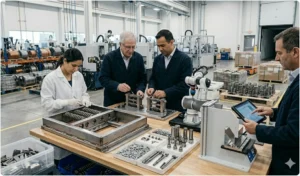
Precision contacts and terminals are the engineered metal interfaces that carry current, signal, or both between two points in an electrical assembly. When stamped to tolerances of ±0.01 mm and finished with selective gold or silver plating, they deliver the low, stable contact resistance that high-performance OEM systems depend on. This guide explains what they are, how they are made, which materials and platings to specify, and where they deliver zero-failure performance across AI, automotive, medical, and industrial applications.
Table of Contents
- What Are Precision Contacts and Terminals?
- Types of Precision Contacts and Terminals
- Materials and Plating for Reliable Connectivity
- How Custom Contacts Are Manufactured
- Where Precision Contacts Deliver Zero-Failure Performance
- Quality, Certifications, and Tolerances
- Why OEMs Partner With HERSHEY
- Frequently Asked Questions
- Request a DFM Review
What Are Precision Contacts and Terminals?
A precision contact is the point where two conductive surfaces meet to complete a circuit—often a spring-loaded pin, clip, or blade. A terminal is the broader interconnect that terminates a wire, busbar, or PCB trace and houses one or more contacts. Together they form the conductive path in everything from a server power shelf to a surgical biosensor.
What makes them “precision” is the tolerance: HERSHEY stamps these parts from thin-gauge stock as light as 0.05 mm and holds geometry to ±0.01 mm, with micro-inch control over plating thickness. That consistency is what keeps contact resistance—and therefore heat and signal loss—predictable across millions of cycles. Explore the full range of custom precision contacts and terminals HERSHEY manufactures.
Types of Precision Contacts and Terminals
Custom programs usually combine several of the following building blocks:
- Electrical contacts – fixed or spring-loaded points for signal and power transfer.
- Battery terminals & cell-tab terminals – high-current interfaces for EV packs and portable devices.
- Busbar terminals – laminated or stamped bars managing continuous currents up to 300 A in server PDUs.
- Precision metal clips – retention and grounding springs for modules and enclosures.
- Micro-pins – fine-pitch connectors for sensors, wearables, and medical hardware.
- Biosensor terminals – gold-plated interfaces demanding zero-defect reliability.
Choosing the right geometry is the first step of any program. Our DFM guide for custom precision contacts and terminals walks engineers through specifying geometry, pitch, and retention before requesting a quote.
Materials and Plating for Reliable Connectivity
Three high-conductivity alloys dominate the category. Each trades cost, strength, and spring behavior differently:
| Material | Key strength | Typical use |
|---|---|---|
| Beryllium Copper (BeCu) | High strength + fatigue life, excellent spring | Slip rings, servo feedback, high-cycle contacts |
| Phosphor Bronze | Good conductivity + formability, lower cost | Clips, connectors, general terminals |
| Stainless Steel (SUS316/301) | Corrosion resistance, biocompatibility | Medical, marine, harsh-environment parts |
Plating is where conductivity and cost meet. Selective gold or silver plating deposits precious metal only where the interface sits, holding contact resistance low while avoiding the expense of full immersion plating. For a side-by-side decision framework, see our precision contact material selection guide.
Quotable data point: Selective gold plating on a beryllium copper contact can keep contact resistance below 10 mΩ while using a fraction of the precious metal required by full immersion plating—critical for high-volume cost control.
How Custom Contacts Are Manufactured: Stamping, Plating & Assembly
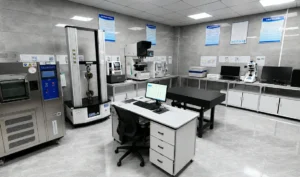
HERSHEY produces contacts on high-speed automated presses using progressive-die and reel-to-reel processes. Material is verified by in-house spectrometer analysis before stamping, and finished parts pass CCD dimensional inspection, salt-spray corrosion testing, and life-cycle fatigue testing.
Selective plating and welded assembly are performed in dedicated workshops added in 2018, enabling one-stop delivery from a single supplier. When evaluating a production partner, our guide to choosing a precision stamping and plating partner covers the capabilities and certifications that separate a manufacturer from a trader.
Where Precision Contacts Deliver Zero-Failure Performance
The same contact family serves radically different duty cycles:
- AI servers & data centers – busbar terminals and micro-pitch pins manage high-amperage continuous current (up to 300 A in PDUs) while minimizing constriction resistance.
- New energy vehicles – high-voltage cell-tab terminals and charging-gun pins use selective silver/gold plating with anti-vibration locking to defeat fretting corrosion.
- Robotics & automation – beryllium copper multi-channel slip-ring contacts and servo feedback terminals suppress electrical noise and micro-arc erosion across high-flex cycles.
- Grid & industrial – laminated copper busbar terminals and copper-nickel-silicon contact blades resist short-circuit surges and contact bounce.
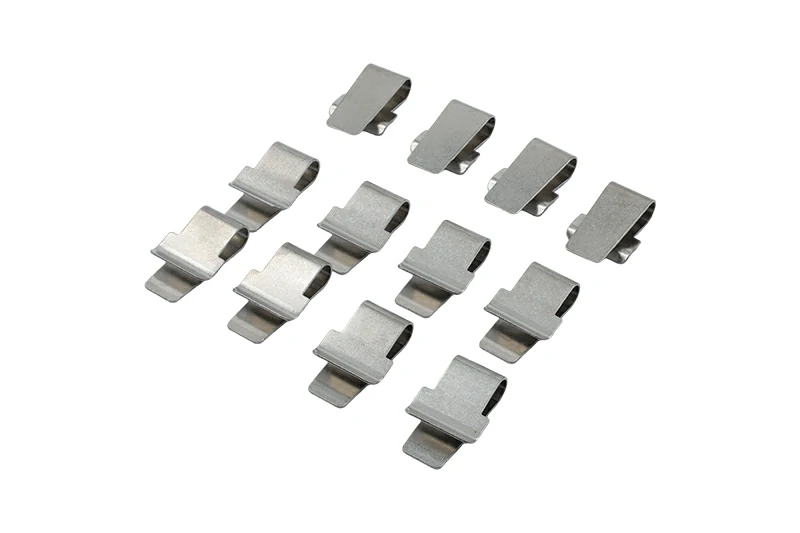
In medical devices, gold-plated micro-pins and biosensor terminals are held to strict micro-inch plating tolerances for flawless data transmission and zero-defect reliability. Our deep dive on precision contacts for medical devices details the design and compliance requirements.
Quality, Certifications, and Tolerances
HERSHEY operates under IATF 16949:2016 and ISO 9001:2015 quality systems, with ISO 13485-controlled processes for medical programs and full REACH/ROHS material compliance. Incoming material is spectrometer-verified; in-process force and torque are monitored; final parts are inspected by CCD, salt-spray, and life testers.
Quotable data point: Tolerances down to ±0.01 mm and plating control to micro-inch levels let the same production line serve both ultra-precision medical micro-pins and heavy-duty industrial blades.
Why OEMs Partner With HERSHEY for Custom Contacts
With 25 years of precision manufacturing experience and 100+ advanced production machines, HERSHEY provides DFM support from concept to mass production. Prototypes are typically delivered in 7–10 days and ramp to 2–3 week mass-production lead times. Since adding stamping and welding workshops in 2018, HERSHEY offers integrated spring, stamping, and welded-assembly supply from one accountable source.
Frequently Asked Questions
What materials are used for precision contact parts?
High-conductivity alloys such as beryllium copper, phosphor bronze, and stainless steel—verified by in-house spectrometer analysis—are the standard, with plating options in gold, silver, tin, and nickel.
Can you hold tight tolerances on micro-sized clips?
Yes. Using German and Japanese equipment, HERSHEY holds tolerances as tight as ±0.01 mm on complex, high-precision electronic components.
What is the typical lead time for custom prototypes?
Initial prototypes are usually delivered within 7–10 days; mass-production lead times typically range from 2 to 3 weeks depending on complexity.
Is the production process ROHS compliant?
Yes. All materials meet REACH and ROHS requirements, verified during incoming inspection and final testing.
Request a DFM Review for Your Custom Contacts
Ready to move from drawing to validated sample? HERSHEY’s engineering team provides DFM feedback, material recommendations, and rapid prototyping for custom contacts and terminals. Request a DFM review or quote and share your engineering drawings to start the conversation.