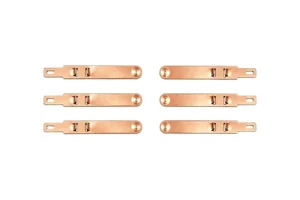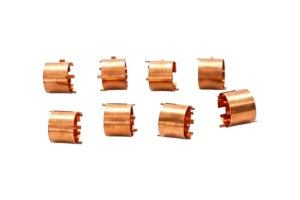
Choosing a manufacturing partner for custom precision contacts and terminals is as much a reliability decision as a sourcing one. The right partner stamps, plates, and assembles your parts under one accountable roof; the wrong one is a middleman who adds cost and risk without controlling the process. This guide gives procurement and engineering leaders a practical checklist for evaluating a precision stamping and selective plating supplier. For background on what these parts are and how they are built, start with our complete guide to precision contacts and terminals.
Table of Contents
- Why Your Manufacturing Partner Determines Contact Reliability
- Core Capabilities: Stamping, Plating, and Assembly
- Certifications That Signal Real Capability
- Equipment and Process Control
- Seven Questions to Ask Before You Commit
- Red Flags: Trader vs Manufacturer
- The Prototype-to-Volume Path
- Why HERSHEY for Custom Contacts
- Frequently Asked Questions
- Request a Capability Review
Why Your Manufacturing Partner Determines Contact Reliability
A contact fails in the field for one of three reasons: wrong material, uncontrolled plating, or a stamping process that drifted out of tolerance. All three are manufacturing decisions, not purchasing-line items. The partner you choose controls whether the spectrometer-verified alloy on the drawing is the alloy in the box, whether gold lands only on the contact face, and whether dimensional variation stays within ±0.01 mm at volume. Our precision contacts guide explains the failure modes in detail; the takeaway is simple—supplier capability is product reliability.
Quotable principle: A trader can quote a contact; only a manufacturer can guarantee one. If your supplier cannot show you the press, the plating line, and the test bench, you are buying a promise, not a part.
Core Capabilities: Stamping, Plating, and Assembly
A true one-stop partner handles the full chain internally rather than subcontracting each step. Look for these specific capabilities when you evaluate a supplier for custom precision contacts and terminals:
- High-speed precision stamping – progressive-die and reel-to-reel presses that form thin-gauge stock from 0.05 mm and hold geometry to ±0.01 mm.
- Selective plating – reel-to-reel gold, silver, tin, or nickel deposition on the contact window only, with micro-inch thickness control.
- Welded assembly – in-house welding workshops that combine stamped contacts with springs or housings into finished sub-assemblies.
- Material verification – in-house spectrometer analysis of every incoming coil before it touches a die.
- Finished-part testing – CCD dimensional inspection, salt-spray corrosion testing, and life-cycle fatigue testing on the production line.
The breadth matters because each handoff to a subcontractor is a point where tolerance, plating, and accountability can degrade. Our complete guide notes that integrated stamping and welding workshops—added in 2018 at HERSHEY—let one supplier own the whole process from drawing to boxed part.
Certifications That Signal Real Capability
Certifications are the cheapest way to separate serious manufacturers from order-takers. For custom contacts and terminals, the relevant framework is broader than a single badge:
- IATF 16949:2016 – the automotive quality management standard; essential if your contacts go into EV or mobility programs.
- ISO 9001:2015 – the baseline quality system for any industrial supplier.
- ISO 13485 – medical-device quality control; non-negotiable for biosensor terminals and implant-adjacent parts.
- ISO 14001 / ISO 45001 – environmental and occupational management, signaling a mature, audited operation.
- REACH / ROHS – material compliance verified at incoming inspection and final testing.
A partner holding IATF 16949, ISO 9001, and ISO 13485 simultaneously is equipped to serve automotive, industrial, and medical programs on the same line—exactly the flexibility described in our precision contacts guide.

Equipment and Process Control
Certificates describe intent; equipment describes reality. Ask what runs the parts:
- Press origin and count – German and Japanese high-speed presses with 100+ advanced production machines indicate a line built for volume and repeatability.
- Plating control – reel-to-reel selective plating with micro-inch thickness monitoring, not dip plating guessed by eye.
- In-process monitoring – force and torque tracked during production, not only at final audit.
- Inspection instrumentation – CCD vision systems, salt-spray chambers, and fatigue testers owned and operated on-site.
When you evaluate a supplier for custom contacts and terminals, the difference between a workshop and a factory is whether this instrumentation is on the floor or outsourced.
Seven Questions to Ask Before You Commit
Use this shortlist in your first supplier call. Weak answers here predict field failures later:
- 1. Do you stamp, plate, and assemble in-house? Subcontracted steps break accountability.
- 2. How do you verify incoming material? Spectrometer analysis of every coil is the bar.
- 3. What is your tightest achievable tolerance? ±0.01 mm on 0.05 mm stock is the production-grade answer.
- 4. Can you selectively plate only the contact face? If they can only dip-plate, you pay for precious metal you do not need.
- 5. Which certifications do you hold? IATF 16949 / ISO 9001 / ISO 13485 for automotive, industrial, and medical.
- 6. What is your prototype lead time? 7–10 days to a validated sample is the competitive benchmark.
- 7. How do you handle a failed lot? Traceability and corrective action under a quality system matter more than a discount.
Our precision contacts guide reinforces that these questions map directly to the failure modes that end contacts in the field.
Red Flags: Trader vs Manufacturer
- No factory tour or live equipment video. A real manufacturer shows the floor; a trader dodges it.
- Vague on plating method. “We plate it” without specifying selective reel-to-reel control is a warning sign.
- Cannot verify material composition. If they trust the mill certificate without spectrometer check, your alloy is an assumption.
- Single certification only. ISO 9001 alone is not enough for automotive or medical programs.
- No in-house testing. Outsourced inspection means slower root-cause and weaker traceability.
- Unrealistic lead times. Promising mass production in days usually means they are reselling, not making.
Each red flag is recoverable only by walking away before tooling. A capability review with the actual manufacturer removes the guesswork up front.
The Prototype-to-Volume Path
A credible partner turns a drawing into a validated sample quickly, then scales without surprises. A typical integrated path:
- Capability review (days 0–3): engineering confirms stamping, plating, and assembly feasibility against your spec.
- Prototype (days 4–10): soft-tool or laser-cut samples are produced and measured against the drawing.
- Validation: CCD dimensional check, salt-spray test, and life-cycle fatigue test confirm the design before hard tooling.
- Mass production (2–3 weeks): progressive dies ramp with in-process force and torque monitoring.
This cadence—prototype in 7–10 days, mass production in 2–3 weeks—is the same one detailed in our precision contacts guide and is a useful benchmark when you compare suppliers.
Why HERSHEY for Custom Contacts
With 25 years of precision manufacturing experience and 100+ advanced production machines, HERSHEY runs stamping, selective plating, and welded assembly under one roof—no trader in the middle. Incoming coils are spectrometer-verified, and finished parts pass CCD, salt-spray, and life-cycle testing under IATF 16949, ISO 9001, and ISO 13485 systems. Integrated workshops added in 2018 mean DFM feedback comes from the team that will actually make the part. Prototypes in 7–10 days and 2–3 week mass-production lead times keep your program moving from drawing to validated volume.
Frequently Asked Questions
Should stamping and plating be in-house?
Ideally yes. Keeping stamping, selective plating, and welded assembly under one supplier preserves tolerance, plating accuracy, and accountability across the whole process instead of splitting it across subcontractors.
Which certification matters most for EV contacts?
IATF 16949:2016 is the key automotive quality standard for EV and mobility programs, paired with ISO 9001 as the baseline. Medical programs instead require ISO 13485.
What tolerance should a capable supplier hold?
A production-grade manufacturer holds geometry to ±0.01 mm on stock as thin as 0.05 mm using German and Japanese high-speed presses—the benchmark to expect when evaluating suppliers.
How fast can a real manufacturer deliver prototypes?
An integrated supplier typically delivers soft-tool or laser-cut prototypes in 7–10 days and ramps to 2–3 week mass-production lead times, letting you validate before committing to hard tooling.
How do I tell a trader from a manufacturer?
Ask for a factory tour or live equipment video, confirm in-house stamping and plating, and verify they spectrometer-check incoming material. A trader will hesitate on all three. Our capability review walks through exactly what to look for.
Request a Capability Review for Your Custom Contacts
Before you commit tooling, ask HERSHEY for a capability review: in-house stamping, selective plating, and welded assembly; IATF 16949 / ISO 9001 / ISO 13485 systems; and a 7–10 day prototype path. Request a capability review or quote and evaluate the manufacturer behind your contacts with confidence.