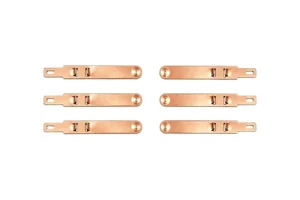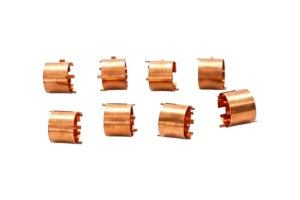
The material you stamp a precision contact from decides everything downstream—contact resistance, fatigue life, corrosion behavior, and even whether the part can be used in the human body. Beryllium copper, phosphor bronze, and stainless steel are the three production workhorses for custom contacts and terminals, and each trades conductivity, strength, and cost differently. This guide gives OEM engineers a clear framework for choosing the right alloy. Review the custom precision contacts and terminals HERSHEY manufactures as a reference while you read.
Table of Contents
- Why Material Choice Defines Contact Performance
- Beryllium Copper (BeCu)
- Phosphor Bronze
- Stainless Steel (SUS316 / 301)
- Head-to-Head Comparison
- How Plating Changes the Equation
- A Decision Framework
- Why HERSHEY for Material Selection
- Frequently Asked Questions
- Request a Material Recommendation
Why Material Choice Defines Contact Performance
A contact is a spring and a conductor at the same time. The alloy sets the ceiling on both. Our complete guide to precision contacts and terminals explains how these parts are built; the short version is that no finishing step—plating, heat treatment, or inspection—can recover a fundamental mismatch between the base metal and the duty cycle. Get the alloy wrong and the contact either relaxes out of spec or costs more than the application can bear.
Quotable principle: Beryllium copper can survive cycles that would fatigue phosphor bronze into failure—so for high-cycle contacts, material is not a cost line item, it is the reliability budget.
Beryllium Copper (BeCu)
Beryllium copper is the high-performance choice when the contact must store spring force and survive millions of cycles. It combines high strength with excellent fatigue life, which is why it appears in HERSHEY’s slip-ring, servo-feedback, and high-cycle contact programs. Where a connector is mated and unmated constantly—or where a spring arm flexes continuously—BeCu earns its higher material cost.
- Strengths: highest strength and fatigue life of the three; stable spring behavior over temperature.
- Trade-offs: higher material cost; conductive but not the highest conductivity.
- Typical uses: slip-ring contacts, servo feedback terminals, high-cycle connectors, precision spring contacts.
Phosphor Bronze
Phosphor bronze is the volume workhorse. It offers good conductivity and excellent formability at a lower cost than beryllium copper, making it the default for clips, general connectors, and terminals where cycle counts are moderate. As covered in our precision contacts guide, phosphor bronze is often the right answer when cost-per-part matters more than maximum fatigue life.
- Strengths: good conductivity, easy to form, lower cost.
- Trade-offs: lower fatigue life than BeCu; less spring force at a given size.
- Typical uses: battery clips, connector contacts, general-purpose terminals, stamped blades.
Stainless Steel (SUS316 / 301)
Stainless steel wins where the environment—not the cycle count—is the threat. Its corrosion resistance and biocompatibility make it the choice for medical, marine, and other harsh-duty contacts. HERSHEY supplies stainless-steel contact and terminal parts for applications where a non-magnetic, corrosion-proof interface is non-negotiable.
- Strengths: best corrosion resistance; biocompatible (316 grade); non-magnetic options.
- Trade-offs: lower conductivity; needs plating to reach low contact resistance.
- Typical uses: medical biosensor terminals, marine hardware, corrosive-environment contacts.
Head-to-Head Comparison
Use this table as a first-pass screening before involving your manufacturer:
| Property | Beryllium Copper | Phosphor Bronze | Stainless Steel (SUS316/301) |
|---|---|---|---|
| Conductivity | Medium | Medium–High | Low |
| Strength / spring | Highest | Medium | High |
| Fatigue life | Highest | Medium | Medium |
| Corrosion resistance | Medium | Medium | Highest |
| Biocompatibility | Limited | Limited | Excellent (316) |
| Relative cost | High | Low–Medium | Medium |
Our complete guide notes that the same production line serves both ultra-precision medical micro-pins and heavy-duty industrial blades—material selection is what separates them.
How Plating Changes the Equation
Material is only half the story—plating is the other half. Selective gold, silver, tin, or nickel deposition turns a mediocre-conductivity base into a low-resistance interface exactly where it matters. A custom contact from HERSHEY typically pairs a functional base alloy (BeCu for spring, stainless for corrosion) with selective precious-metal plating on the contact face. This is how stainless steel—poor in raw conductivity—still delivers reliable, low-resistance medical and industrial contacts.
A Decision Framework
Pick the alloy by asking three questions, then confirm with your manufacturer:
- How many cycles? High-cycle or continuously flexing → beryllium copper. Moderate → phosphor bronze.
- What environment? Corrosive, wet, or in-body → stainless steel (316). Dry indoor → BeCu or bronze.
- What is the conductivity target? Below 10 mΩ contact resistance usually needs selective gold/silver plating on top of any base metal.
The precision contacts guide reinforces this: define the electrical and environmental spec first, then let the alloy follow.
Why HERSHEY for Material Selection
HERSHEY verifies every incoming coil by in-house spectrometer analysis before stamping, so the beryllium copper, phosphor bronze, or stainless steel on your drawing is the material in your delivered box—not a substitute. With IATF 16949, ISO 9001, and ISO 13485 systems in place, the same material discipline serves automotive, industrial, and medical programs. Share your duty cycle and environment and the engineering team will recommend the alloy and plating window that meet the spec at the lowest total cost.
Frequently Asked Questions
Which material is best for high-cycle contacts?
Beryllium copper. Its fatigue life and spring stability under repeated deflection make it the standard for slip rings, servo feedback, and connectors that mate and unmate constantly.
Is phosphor bronze good enough for most terminals?
For moderate-cycle clips, connectors, and general terminals, yes. It balances conductivity and formability at a lower cost than beryllium copper, which is why it is the high-volume default.
Can stainless steel be plated for conductivity?
Yes. Selective gold or silver plating on the contact face gives stainless steel the low contact resistance it lacks in raw form, which is exactly how medical and corrosive-environment contacts are built.
Does HERSHEY verify material composition?
Yes. Every incoming coil is analyzed by spectrometer before stamping, and final parts pass CCD dimensional, salt-spray, and life-cycle testing under IATF 16949 / ISO 9001 / ISO 13485 systems.
Which material suits medical biosensors?
Stainless steel (316) for biocompatibility, or beryllium copper where spring force matters, both finished with selective gold plating for flawless, zero-defect signal transfer under ISO 13485 control.
Request a Material Recommendation for Your Contacts
Send HERSHEY your duty cycle, environment, and target contact resistance, and the engineering team will recommend the right alloy and plating window—beryllium copper, phosphor bronze, or stainless steel—validated by spectrometer analysis and prototype testing. Request a material recommendation or quote to specify with confidence.