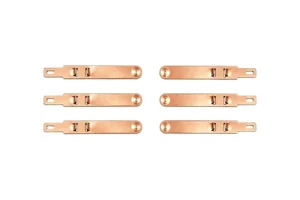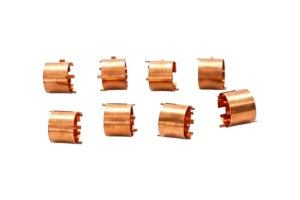
Why This Guide Matters
A metal clip or spring clip is one of the smallest parts in a product, yet it often decides whether an assembly stays reliable. These stamped parts hold, retain, position, or connect components in EV battery packs, industrial robots, AI servers, and medical devices. They look trivial, but the wrong clip — wrong material, wrong force, wrong finish — turns into a loose contact, a fretting failure, or a field return. This guide is the complete starting point for engineers and buyers who need to specify, compare, and source custom clips with confidence. For our full production scope, see the precision contacts and terminals capabilities page.
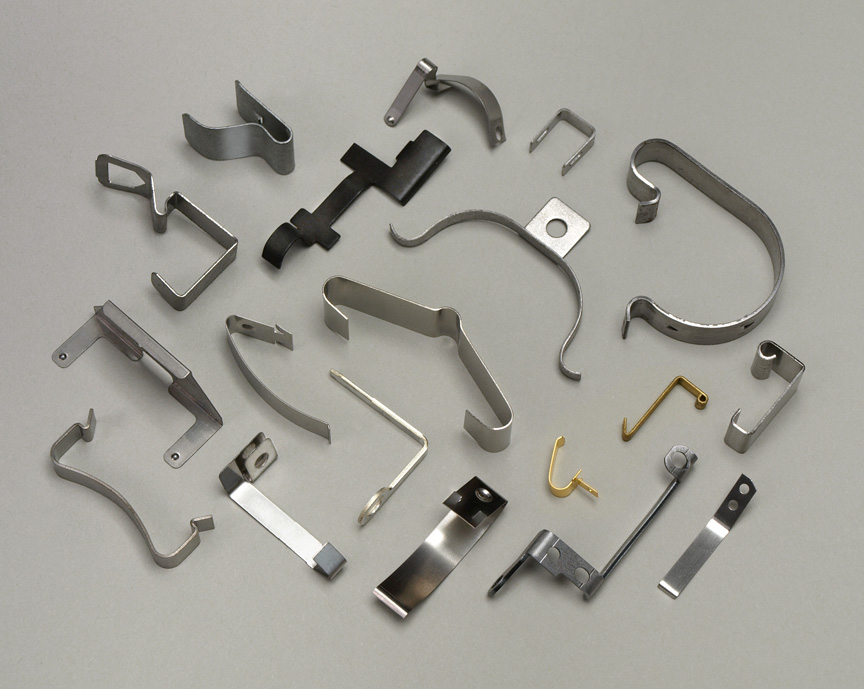
Table of Contents
- 1. What Are Metal Clips and Spring Clips?
- 2. The Clip Family at a Glance
- 3. Where Clips Earn Their Keep
- 4. Why Clips Fail — and How to Design It Out
- 5. Metal Clip or Spring Clip? A Practical Selection Path
- 6. Materials and Finishes That Hold Up
- 7. How a Custom Clip Is Made
- 8. Tolerances, DFM, and What to Send Your Supplier
- 9. Quality You Can Verify
- 10. Common Specifying Mistakes to Avoid
- 11. How to Order Custom Metal Clips
- 12. Choosing a Clip Manufacturer
1. What Are Metal Clips and Spring Clips?
A metal clip is a stamped or formed piece of thin sheet metal that grips, retains, or positions a part by its shape. Most metal clips hold through fit and geometry rather than active force, so they suit static joints where the part stays put — a wire routed to a board, a pin held in a groove, a cell locked in a pack.
A spring clip adds elastic tension. It uses its own spring force to keep holding a part under load, so it keeps working when the assembly moves, vibrates, heats up, or wears. The spring action also soaks up tolerance variation across a production batch, which is why spring clips show up in moving and current-carrying joints.
Both families come from precision stamping of thin strip, usually followed by selective plating for conductivity or corrosion protection. The choice between them drives material, tooling, and cost: a plain metal clip is usually cheaper at high volume, while a spring clip pays off where the joint must stay reliable under movement.
2. The Clip Family at a Glance
Before comparing, it helps to see the common forms and what each one is built to do:
| Clip type | What it does | Typical use |
|---|---|---|
| Retaining & locating clips | Hold a shaft or pin in a set position | Gearboxes, sensors, brackets |
| E-clips & circlips | Snap into a groove to retain a part axially | Shafts, bearings, linkages |
| Wiring & PCB terminal clips | Secure wires or fix a connector to a board | Control units, modules |
| Battery locking clips | Lock cells and tabs against vibration | EV packs, storage |
| Busbar & contact clips | Join conductive paths under current | Power units, terminals |
| Snap rings / circular spring clips | Retain parts in a bore or on a shaft with force | Motors, actuators |
| Wave & laminated clips | Supply controlled preload over a wide deflection | Stacks, dampers, connectors |
| Spring contact fingers | Maintain contact pressure in connectors and relays | Connectors, relays, switches |
| Anti-vibration locking clips | Stop fretting and loosening under vibration | Automotive, rail, machinery |
Most programs mix several of these. A battery module may use locating clips, busbar contact clips, and anti-vibration locks in the same pack.
3. Where Clips Earn Their Keep
Clips are reliability nodes: a single loose or high-resistance contact can take a whole module offline. That is why material and finish matter as much as shape. A few representative duty cycles:
- EV and battery systems. Cell-tab terminals and charging-gun pins carry high current and must resist fretting corrosion through thermal cycling. Busbar terminals in AI server power units can run continuous current up to 300 A. When you source contacts for EV packs, it pays to shortlist suppliers already running automotive-grade lines — our EV and battery contact supplier list is a practical starting point.
- Industrial automation and robotics. Servo feedback terminals and slip-ring contacts fight electrical noise across millions of flex cycles, so fatigue life and stable contact resistance are the real specs, not just shape.
- AI servers and data centers. Micro-pitch busbar pins and connector springs deliver continuous high current in tight spaces, where a 0.01 mm drift changes the mating force.
- Consumer and appliance. Relay pins, connector springs, and latch clips must survive thousands of cycles at low cost — here stamping volume, not exotic material, drives the decision.
In each case the clip is doing quiet, constant work. The sections below show how to spec it so it keeps doing that work.
4. Why Clips Fail — and How to Design It Out
Understanding failure modes is the fastest way to a reliable clip. The common ones:
- Fretting and loosening. Micro-slip under vibration wears the contact and grows resistance. Countermeasure: use a spring clip that holds constant force, or add an anti-vibration lock. For high-vibration joints, the spring clip usually wins on fretting resistance — we compare metal vs spring clips under vibration with field failure modes.
- Stress relaxation. Over time the clip loses force and the joint loosens. Countermeasure: pick a material with low relaxation at the operating temperature (beryllium copper and phosphor bronze hold force far better than mild steel).
- Corrosion. The finish breaks down and resistance climbs or the part seizes. Countermeasure: match the plating to the environment (see the salt-spray table below).
- Fatigue. Repeated flex cracks the clip. Countermeasure: control stress concentration at bends and verify cycle life on samples.
- Over-stress at assembly. A clip forced past its deflection limit takes a permanent set. Countermeasure: tolerance the mating parts and confirm the install force in prototyping.
None of these are solved by a thicker clip alone. They are solved by matching material, force, finish, and tolerance to the duty cycle — which is exactly what a good supplier reviews before tooling.
5. Metal Clip or Spring Clip? A Practical Selection Path
Pick the family by how the joint behaves, then confirm with the table:
- Does the part move or vibrate? If yes, lean spring clip.
- Does it carry signal or current? If contact pressure must stay constant, lean spring clip.
- Is the joint static and high-volume? A plain metal clip is usually the cheaper call.
- Is the environment harsh or outdoor? Then material and finish decide more than the family — and metal also beats plastic on long-term durability, as our metal-vs-plastic comparison lays out with the numbers.
| Factor | Metal clip | Spring clip |
|---|---|---|
| Force source | Shape and press fit | Elastic spring tension |
| Best for | Static, fixed joints | Moving, vibrating, current-carrying joints |
| Tolerance to stack-up | Lower | Higher (absorbs variation) |
| Typical cost driver | Stamping volume | Material and heat treatment |
6. Materials and Finishes That Hold Up
Material sets conductivity, fatigue life, and corrosion resistance. For spring contacts the usual starting points:
- Beryllium copper — high conductivity plus excellent fatigue life; the default for signal clips and relays.
- Phosphor bronze — balanced conductivity and spring performance at lower cost; the workhorse for general spring clips.
- Stainless steel — strong and corrosion-resistant; used where current is low and strength matters.
- Specialty copper alloys — selected for high-wear contact blades and demanding environments.
Plating refines the surface: gold and silver lower contact resistance, tin and nickel protect against corrosion and aid solderability. We keep a 23-process surface-finishing library; the options most relevant to clips and contacts:
| Finish | Main role | Longest salt spray | Typical use |
|---|---|---|---|
| Gold plating | Conductive, oxidation-resistant | 240h | High-end connectors, contacts |
| Silver plating | Conductive | 48h (tarnish-prone) | High-frequency contacts |
| Tin plating | Solderability | 240h | Electronic terminations |
| Nickel plating | Corrosion, decorative | 48–72h | Electronic parts |
| Zinc plating | Corrosion protection | 240h | Fasteners, stampings |
| Dacromet | High corrosion | 3000h | Automotive fasteners |
| Zinc-aluminum coating | Corrosion | 2000h | Outdoor structures |
| Hard anodizing | Corrosion, color | 320h | Aluminum parts |
Salt-spray figures are the longest reference values from our finishing library; actual results vary with substrate, pretreatment, coating thickness, and test conditions. The full library spans 8 categories and salt-spray ranges from 8h to 3000h.
7. How a Custom Clip Is Made
A reliable clip is the sum of process control, not just a drawing. The typical flow:
- Strip preparation. Thin strip or fine wire is fed into high-speed progressive dies.
- Precision stamping and forming. Imported precision forming equipment with multi-axis control holds tight geometry on micro parts.
- Selective plating. Gold, silver, tin, or nickel is applied only where needed, with controlled thickness for low contact resistance.
- Assembly where required. Clips can ship as part of a larger stamped-and-welded component rather than loose parts.
Because HERSHEY runs spring + stamping + welding + assembly under one roof, a clip that later needs a spring or a welded bracket does not have to change suppliers mid-program. For the full scope — including contacts, terminals, and busbars — see the precision contacts and terminals capabilities page.
8. Tolerances, DFM, and What to Send Your Supplier
You do not need a perfect drawing to start, but a few items make the first quote accurate and fast:
- A 2D print with tolerances on the features that matter (mating dimensions, thickness, spring gap).
- Material and temper called out, or a target performance (force, cycles, current) if you want the supplier to propose the alloy.
- Plating type and area — full or selective, and the thickness target.
- Operating condition — temperature range, vibration, current, environment — so finish and material are matched.
- Expected annual volume — this sets whether progressive-die tooling pays off.
A supplier that reviews these up front (DFM feedback before tooling) saves more than it costs. Share the drawing and the duty cycle, and let the shop flag the risky features early.
9. Quality You Can Verify
Quality is built into incoming material and finished-part checks, not inspected in at the end. Our system:
- Incoming verification — material composition is checked before stamping so the alloy you specify is the alloy you receive.
- In-process control — IQC, IPQC, and OQC stages with CCD inspection on critical geometry.
- Finished-part testing — salt-spray, life-cycle, and load testing in our experimental testing center before shipment.
- Certified management — IATF 16949:2016, ISO 9001:2015, ISO 14001, ISO 13485, ISO 45001, and ISO 50001, with REACH and ROHS compliant materials. We work to common spring and stamping references such as DIN and ISO spring standards and can supply material certs on request.
That paper trail is what lets a clip qualify for automotive, medical, and high-reliability programs without a second qualification round.
10. Common Specifying Mistakes to Avoid
- Over-tolerancing. Tight numbers on non-critical features raise cost with no benefit. Tolerance the mating features; relax the rest.
- Choosing material by habit. Specifying stainless where phosphor bronze would hold force better is a common, quiet failure.
- Ignoring the environment. A finish picked for a lab will not survive salt spray. Match plating to duty.
- Skipping first-article samples. Verifying fit and force on samples before tooling prevents a costly tool change later.
- Leaving volume out of the RFQ. Without annual quantity, the supplier cannot pick the right tooling and the quote drifts.
11. How to Order Custom Metal Clips
Use this quick reference to scope your order before you request a quote:
| Parameter | Typical capability |
|---|---|
| Wire / strip range | 0.03 mm to 25 mm |
| Tolerance on micro parts | Down to ±0.01 mm |
| Plating | Selective gold, silver, tin, nickel (in-house) |
| Production base | 10,000㎡ plant, 100+ automated machines, 30+ inspection devices |
| Certifications | IATF 16949:2016, ISO 9001:2015, ISO 14001, ISO 13485 |
Then follow a clean ordering path:
- Send your drawing or sample. A 2D print with tolerances and a material callout is enough to start.
- Confirm the key specs. Material, thickness, plating type and area, and tolerance.
- Build first-article samples. We return samples quickly so you can verify fit and function before committing to tooling.
- Plan tooling and MOQ. Progressive-die tooling spreads cost across volume, so state your expected annual quantity early. Tooling and annual volume set most of the unit price; our clip-cost breakdown walks through the levers.
- Scale to mass production. After approval, volume runs ship against a 95%+ on-time delivery record.
12. Choosing a Clip Manufacturer
Working with a true manufacturer — not a trading firm — gives you DFM feedback, stable quality, and shorter lead times. HERSHEY brings:
| Capability | What it means for your order |
|---|---|
| 20+ years of precision manufacturing | DFM input from concept to production (core team since 2000) |
| 10,000㎡ base, ~150 staff | Stable capacity and accountable program management |
| 100+ automated machines, 30+ inspection devices | Scalable from prototype to high volume |
| Imported precision forming equipment, multi-axis control | Tolerances to ±0.01 mm on micro parts |
| Four-process synergy (spring + stamping + welding + assembly) | One-stop system solutions, fewer hand-offs |
| In-house selective plating | Gold, silver, tin, nickel with controlled thickness |
| Full cert stack + REACH / ROHS | Traceable, repeatable batch quality |
| 6,000+ global customers, incl. Fortune 500 | Proven in high-reliability programs |
| 95%+ on-time delivery | Supply stability for your production line |
We are one of several shops that can run this program; our spring-clip supplier shortlist shows the points worth comparing side by side before you award the work.
Get a Quote
Send your drawing or sample and we will return a quote with material, plating, MOQ, and lead time. Start on our contact page, or use the live chat to talk to an engineer now.
FAQ
What tolerance can you hold on custom clips?
On micro stamped parts we hold tolerances as tight as ±0.01 mm using imported precision forming equipment with multi-axis control.
How fast can I get first-article samples?
We return first-article samples quickly so you can confirm fit and function before tooling. Share your drawing and we will propose a sample plan.
Do you plate in-house?
Yes. We apply selective gold, silver, tin, and nickel plating with controlled thickness for low contact resistance and corrosion protection.
What is the minimum order quantity?
MOQ depends on the part and tooling. Share your drawing and expected volume and we will quote a workable MOQ. Our cost guide covers the main price drivers.
Can you match my exact drawing?
Yes. All clips are made to your print, with DFM review before tooling begins, and finished-part testing before shipment.
Which certifications do you hold?
IATF 16949:2016, ISO 9001:2015, ISO 14001, ISO 13485, ISO 45001, and ISO 50001, with REACH and ROHS compliant materials.