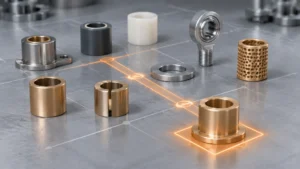
The right bushing depends on four things: load direction, lubrication, operating conditions, and maintenance access. A sleeve bushing usually suits a rotating shaft under radial load. A flanged bushing adds an axial contact surface. A thrust washer handles axial loads, while a spherical bushing accommodates angular movement.
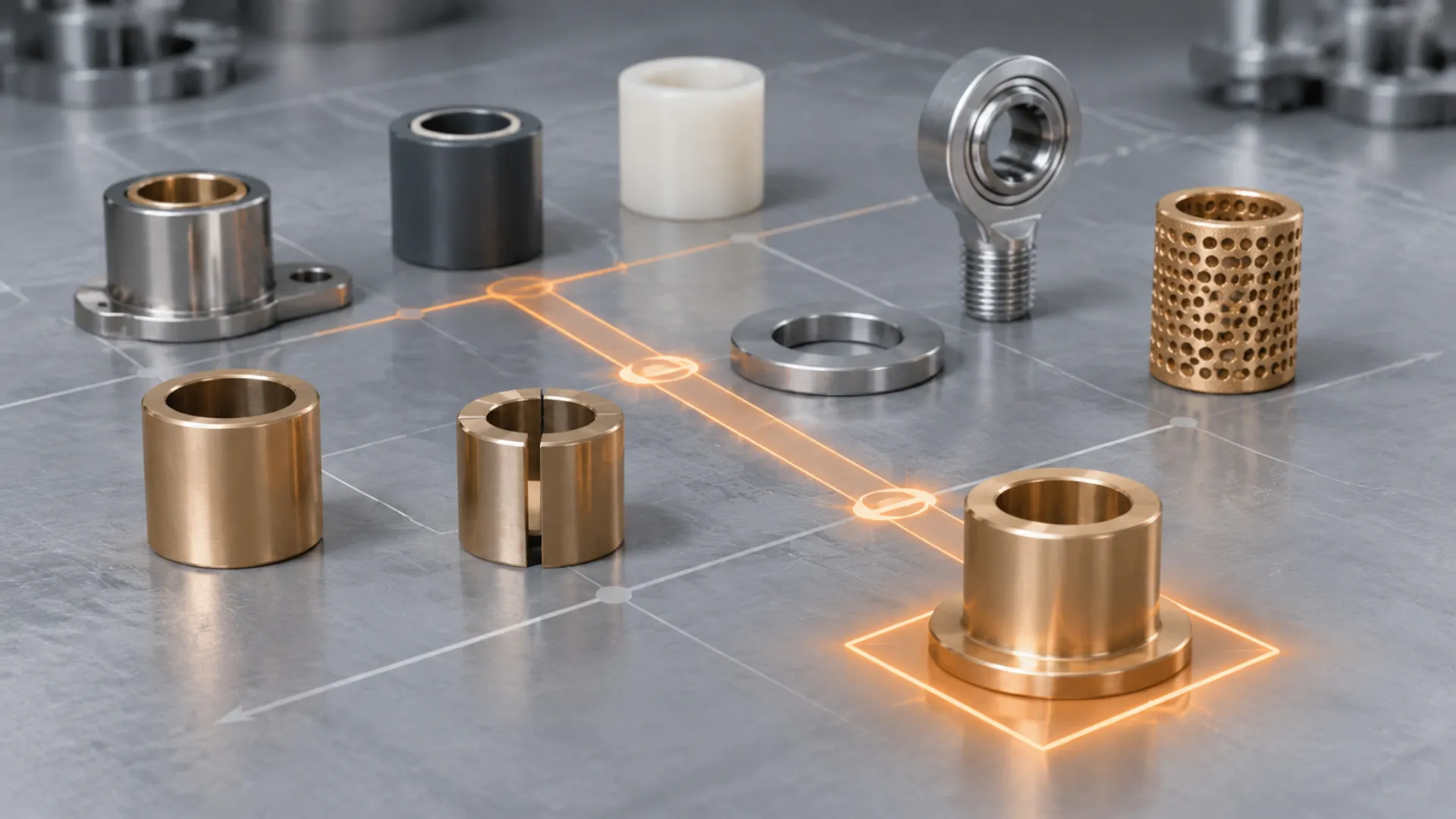
These types are not interchangeable. Choosing a bushing by name alone can lead to excessive wear, poor alignment, or installation problems. A component may fit the housing perfectly but still fail because its material or lubrication method does not match the operating conditions.
This guide explains how bushing geometry, material, and lubrication work together. It then provides a practical selection process, common failure modes, and the specifications to confirm before ordering.
The objective is straightforward: select a bushing that meets the application’s requirements without adding unnecessary cost, maintenance, or installation complexity.
What Counts as a Bushing — and What Doesn’t
The Functional Definition That Separates Bushings from Bearings, Washers, and Clips
A bushing is a component installed between two mating parts to provide a controlled contact surface. It usually supports sliding or rotational movement while carrying a load. In a typical assembly, it sits between a shaft or pin and a housing, guiding the moving part and protecting the surrounding components from wear.
Most bushings work as plain sliding bearings. They support movement through direct contact between the bushing surface and the moving component rather than through balls or rollers.
The load direction helps identify the type of support an assembly needs:
- Radial load: Acts perpendicular to the shaft axis. A sleeve bushing around a rotating shaft typically carries this load.
- Axial load: Acts parallel to the shaft axis. A thrust washer or thrust bushing provides a sliding surface to resist this movement.
- Combined load: Includes both radial and axial forces. A flanged bushing can support radial loading through its sleeve and axial contact through its flange.
Not every component that separates two parts or reduces friction is a bushing.
- Rolling-element bearings use balls, needles, or rollers to support movement. They perform a similar supporting function but use a different bearing mechanism.
- Thrust washers provide a flat sliding surface for axial loads. They can be plain bearing elements, but they are not necessarily cylindrical bushings.
- Retaining clips hold components in position. They provide mechanical retention, not a dedicated sliding bearing surface.
- Spacers maintain distance between components. Unless they are designed to support sliding contact, they should not be treated as bushings.
This distinction matters during specification. A spacer that fits between two parts may not have the material, surface finish, or clearance needed for continuous sliding contact.
Why “Plain Bearing” and “Bushing” Are Not Always Interchangeable
Plain bearing is the broader term. It describes a bearing that supports relative movement through sliding contact rather than rolling elements. A bushing is one common form of plain bearing, but the category also includes thrust plates, bearing strips, and other sliding components.
For example, a cylindrical bronze sleeve pressed into a housing is both a bushing and a plain bearing. A flat polymer thrust washer is also a plain bearing element, but calling it a sleeve bushing would be inaccurate.
Manufacturers may use terms such as plain bearing, sleeve bearing, and sleeve bushing in overlapping ways. When comparing products, check the geometry, load direction, mounting method, and operating conditions. The catalog name alone is not enough.
The Three Axes That Generate Every Bushing Type
Most bushing classifications come down to three variables: shape, material, and lubrication. Each answers a different engineering question.
- Shape: How does the bushing fit into the assembly, and which load directions can it support?
- Material: Can it handle the required load, sliding speed, temperature, and environment?
- Lubrication: Does it need external oil or grease, retain its own lubricant, or operate without an external supply?
These terms describe different features. Flanged refers to geometry, bronze identifies a material family, and oil-impregnated describes a lubrication method. A single bushing can be flanged, made from bronze, and oil-impregnated.
Shape: How It Is Retained and What Load Direction It Carries
Geometry determines how a bushing sits in the assembly and how forces pass through it.
- Sleeve or plain bushing: A cylindrical component installed in a housing. It is commonly retained by an interference fit and primarily supports radial loads around a rotating or oscillating shaft.
- Flanged bushing: A cylindrical sleeve with a flange at one end. The sleeve supports radial loads, while the flange provides an axial sliding surface and helps locate the component.
- Thrust washer: A flat or ring-shaped bearing element that supports axial sliding loads. It is usually held in position by the surrounding assembly rather than by a cylindrical press fit.
- Split or clinch bushing: A bushing with a split or formed locking feature. This design can simplify installation when access is restricted or a solid press-fit component is difficult to install.
- Spherical bushing: Uses curved mating surfaces to accommodate angular movement or misalignment. Its load capacity depends on the design and contact arrangement.
- Stepped or shouldered bushing: Has changes in outside diameter or integrated shoulders for positioning, different mounting diameters, or clearance around adjacent parts.
Choose the geometry that matches the assembly’s movement and retention requirements. If a shaft only needs radial support, adding a flange may increase cost and installation complexity without solving a real problem.
Material: What Load, Speed, and Temperature It Can Survive
The material affects wear, friction, heat generation, deformation, and corrosion resistance. The following table summarizes common material families and the conditions that need attention.
| Material | Main Characteristics | Operating Considerations | Common Applications |
|---|---|---|---|
| Cast Bronze | Good bearing properties, wear resistance, and machinability | Load capacity and lubrication requirements depend on the alloy and operating conditions | Industrial machinery, pumps, heavy-duty pivots |
| Sintered Bronze | Porous structure that can retain lubricating oil | Often used for moderate loads where the retained oil supply suits the operating cycle | Electric motors, fans, small machinery |
| Bimetal | Steel backing bonded to a bearing alloy layer | Bond strength, bearing-layer properties, and loading cycles need to be checked | Automotive engines, compressors, industrial equipment |
| PTFE Composite | Low-friction sliding surface; some designs can run without external lubrication | Check pressure-velocity limits, temperature, creep, and shaft compatibility | Hydraulic equipment, industrial pivots, maintenance-sensitive assemblies |
| POM Composite | Good dimensional stability and wear resistance, with relatively low moisture absorption | Temperature and pressure-velocity limits depend on the formulation | Automotive linkages, household equipment, mechanical guides |
| Hardened Steel | High hardness and resistance to deformation | Usually requires suitable lubrication and a compatible mating surface | Heavy-duty pivots, precision mechanisms, industrial joints |
| Solid Plastic | Low weight, corrosion resistance, and electrical insulation in selected grades | Account for creep, thermal expansion, wear, and moisture-related dimensional changes | Food-processing equipment, water-related mechanisms, lightweight assemblies |
These are material categories, not universal performance ratings. The allowable load, speed, and temperature depend on the exact alloy or polymer grade, bushing dimensions, shaft finish, lubrication, and operating environment.
Material selection also depends on lubrication. A PTFE composite may suit a joint that cannot receive regular oil or grease. An oil-impregnated bronze bushing may suit a compact motor where a retained oil supply can support the operating cycle. The two designs solve different maintenance problems.
Do not select a material based only on hardness or a catalog load rating. Check its compatibility with the shaft and the intended lubrication method.
Lubrication: The Axis That Decides Maintenance Strategy, Not Just Friction
Lubrication determines how friction is controlled during operation and how often the assembly needs attention. Three common approaches are used.
Oil-Impregnated
Oil-impregnated bushings are commonly made from sintered bronze. Their porous structure stores oil, which can migrate toward the sliding surface during operation.
They are often used in electric motors, fans, and compact mechanisms where adding lubricant regularly would be inconvenient. They still have operating limits: excessive load, heat, or an unsuitable duty cycle can reduce their service life.
Grease-Required
Grease-lubricated bushings receive lubricant during installation or through a grease fitting. The grease forms a film between the bushing and shaft and can help keep contaminants away from the sliding interface.
This approach is common in industrial pivots, construction equipment, and agricultural machinery, where loads can be high and lubrication points are accessible during maintenance.
Dry-Running or Self-Lubricating
Dry-running bushings use materials or embedded lubricating compounds to reduce friction without a continuous external oil or grease supply. Examples include PTFE composites, certain polymer bearings, and bronze bushings with solid lubricant plugs.
They are useful when regular lubrication is difficult or when oil and grease could contaminate nearby components. However, dry-running does not mean wear-free or maintenance-free. Load, temperature, contamination, and operating cycles still determine service life.
The same base material can support different lubrication strategies. A sintered bronze bushing that retains oil and a solid-lubricant-plugged bronze bushing do not have the same maintenance requirements.
The Type-by-Type Reference — Organized for Comparison, Not Reading
Use this section to compare the main bushing types by function. The important question is not only what each design can do, but also where it stops being suitable.
Sleeve / Plain — The Default, and the Baseline for Every Comparison
A sleeve bushing is a cylindrical bearing fitted between a shaft and a housing. It supports sliding or rotational movement and is commonly retained by an interference fit. Typical materials include bronze, steel-backed composites, and polymers.
Choose it when the assembly mainly carries radial loads, the shaft remains reasonably aligned, and a cylindrical bearing surface is sufficient. Look elsewhere if the bushing must also control significant axial movement or accommodate angular misalignment.
Flanged — When Axial Location Must Be Built into the Bushing
A flanged bushing combines a cylindrical sleeve with an integrated flange. The sleeve carries radial loads; the flange provides an axial contact surface and can help locate the bushing in the housing.
Choose it when the assembly needs radial support and a simple axial locating surface without a separate thrust washer. Do not assume the flange can carry any axial load. Its thickness, contact area, material, and lubrication must match the application. A dedicated thrust bearing may be more suitable when axial pressure is high.
Thrust — Pure Axial Load, No Radial Confusion
A thrust bushing or thrust washer provides a sliding surface between components that move or press against each other along the shaft axis. Its shape is usually flat or ring-shaped rather than cylindrical.
Choose it when axial forces dominate and the assembly needs a defined surface to control end movement. It cannot replace a radial sleeve bushing because it does not provide the same cylindrical support around a shaft.
Split / Clinch — Assembly-Driven Geometry
A split bushing has an opening along its cylindrical wall. A clinch-style design uses formed features to secure the component in its mounting position. Both can simplify installation when access is limited or a conventional solid bushing is difficult to fit.
Choose this type when the assembly sequence, installation access, or retention method is the main constraint. Check whether the split or formed feature reduces stiffness or causes deformation under the expected load. If it does, a solid design may be more suitable.
Spherical / Rod-End — Misalignment Accommodation
Spherical bushings use curved sliding surfaces to allow angular movement between connected parts. Rod-end bearings commonly contain a spherical bearing element within a housing, allowing the joint to accommodate misalignment while transferring loads.
Choose this arrangement when connected parts move through an angle or cannot maintain perfect alignment throughout operation. For a straight, accurately aligned rotating shaft, a conventional sleeve bushing is usually a simpler starting point.
Oil-Impregnated and Self-Lubricating Variants — The Maintenance-Free Branch
Oil-impregnated bushings store lubricant in a porous structure. Self-lubricating designs use materials such as PTFE composites or solid-lubricant-filled bronze to reduce the need for external oil or grease. Both can reduce routine lubrication work, but they work in different ways.
Consider oil-impregnated designs for applications where the retained oil supply matches the load and operating cycle. Consider self-lubricating designs when external lubricant is unavailable or undesirable. Neither should be treated as an automatic solution for high loads, high speeds, or elevated temperatures.
Specialty Forms: Stepped, Shouldered, and Application-Specific Geometries
Stepped and shouldered bushings have changes in diameter or integrated positioning features. These details allow the component to fit a specific housing, shaft, or surrounding assembly. Other application-specific designs may include grooves, slots, mounting features, or non-standard wall thicknesses.
Use a custom geometry when a standard sleeve or flanged bushing cannot meet the mounting or positioning requirements. If a standard part performs the same function, it is usually the simpler option. Custom designs can add machining, tooling, inspection, and replacement costs.
How to Narrow the List — Four Questions That Eliminate Most Types
Follow the same selection order for each application: identify the load direction, establish the lubrication method, check speed and temperature, and then decide how the bushing will be maintained.
This order matters. There is little value in comparing material grades before confirming that the geometry can support the load.
Question 1 — Is the Load Radial, Axial, or Both?
Start by identifying the direction of the force acting on the bushing. This is the first filter because geometry determines how the bearing surface supports movement.
- Primarily radial load: Start with sleeve or plain bushings.
- Radial load plus axial positioning: Consider a flanged bushing.
- Primarily axial load: Consider a thrust washer or thrust bushing.
- Combined loading with angular movement: Evaluate spherical or specially designed bearing arrangements.
A flange does not automatically make a bushing suitable for heavy axial loading. Check its thickness, bearing area, material, and lubrication conditions.
Also identify how the load changes during operation. A steady load, reversing force, and repeated impact can produce very different wear and fatigue conditions, even when their maximum force is similar.
Question 2 — Is Lubrication Possible, or Must the Joint Run Dry?
Next, check whether the assembly can receive lubricant during operation or scheduled maintenance.
If a reliable lubrication system is available, an externally lubricated bronze or composite bushing may be suitable. If there is no practical way to replenish lubricant, consider oil-impregnated or dry-running designs.
But the absence of an oil or grease supply does not make every self-lubricating bushing suitable. Check its pressure-velocity limits, temperature range, and compatibility with the shaft surface.
For example, an oil-impregnated sintered bronze bushing may work in a compact electric motor. A dry-running composite may be a better option near components that must not be exposed to oil leakage.
Consider contamination requirements as well. Food-processing, medical, and clean manufacturing environments may restrict the types of lubricants that can be used, especially where product-contact requirements or applicable regulations are involved.
Question 3 — What Is the Speed and Temperature Envelope?
Once the load and lubrication method are known, check the operating speed and temperature. Both affect friction, heat generation, and wear.
For sliding bushings, pressure-velocity value is a useful initial screening parameter:
PV = P × V
Where:
- P is the projected bearing pressure.
- V is the relative sliding velocity at the bearing surface.
- PV represents the combined pressure and velocity condition.
For a cylindrical sleeve bushing, projected bearing pressure can be estimated as:
P = F / (D × L)
Here, F is the radial load, D is the shaft diameter, and L is the effective bearing length. Use consistent units when calculating pressure.
For a rotating shaft, sliding velocity can be estimated as:
V = π × D × n / 60
Here, D is the shaft diameter in meters and n is the rotational speed in revolutions per minute.
These calculations help screen candidate materials; they do not approve a design by themselves. Compare the result with the manufacturer’s PV limits for the specific material and lubrication method. Also account for surface finish, operating temperature, duty cycle, starting friction, intermittent operation, edge loading, and heat dissipation.
Temperature can change which material is suitable. Polymer bushings may soften, creep, or change dimensions as temperature rises. Bronze and steel-based designs may tolerate higher temperatures in some applications, but lubricant limits and mating-surface requirements still apply.
Use the complete operating range, not one maximum-load or maximum-temperature figure, to select the material.
Question 4 — Is the Bushing a Wear Part That Will Be Replaced, or a Permanent Interface?
Finally, decide how the bushing will be serviced. Some designs are intended to be replaced during scheduled maintenance. Others are expected to remain in place for most or all of the equipment’s service life.
- Replaceable wear part: Prioritize accessible mounting, standard dimensions, and materials that are practical to inspect and replace.
- Long-life interface: Give more weight to wear resistance, environmental compatibility, dimensional stability, and lubrication reliability.
- Limited-access assembly: Consider split, clinch, or application-specific designs when installation or replacement access is restricted.
A replaceable bronze bushing may be more practical than a costly long-life design if the equipment already has scheduled maintenance. On the other hand, an inaccessible joint may justify a longer-life composite even when its initial price is higher.
The Failure Modes That Should Influence Your Type Choice
A catalog load rating does not tell the whole story. Shaft finish, lubrication, installation, material compatibility, and operating cycles can all cause premature failure.
Before confirming a design, check the following four failure modes.
Wear and Galling — When Material Compatibility Matters More Than Load Rating
Wear occurs when repeated sliding contact gradually removes material from the bushing or shaft. Its rate depends on contact pressure, sliding speed, lubrication, surface finish, contamination, and material compatibility.
Galling is a more severe form of adhesive wear. Material transfers between contacting surfaces, potentially causing scoring, seizure, or rapid damage. It can occur when metal surfaces slide against each other under high contact pressure, especially when lubrication is inadequate.
For example, a metal bushing may have enough nominal load capacity but still wear quickly if the shaft surface is too rough or the lubricant film repeatedly breaks down.
To reduce the risk:
- Check the shaft hardness and surface finish requirements.
- Confirm compatibility between the bushing and shaft materials.
- Evaluate lubrication under the actual operating conditions.
- Consider suitable dissimilar-material sliding pairs where appropriate.
- Check whether abrasive particles can enter the bearing interface.
A compatible material pair and reliable lubrication can matter more than a high static load rating.
Fatigue and Cracking — The Dynamic-Loading Branch
Repeated loading can cause fatigue damage even when the maximum force remains below the material’s nominal static capacity. Reversing loads, vibration, and impact create cyclic stresses in the bearing material, backing layer, or mounting interface.
Bimetal bushings, for example, combine a steel backing with a bonded bearing alloy layer. Both the bond and the bearing layer must withstand the application’s loading cycle. Excessive stress, poor alignment, or unsuitable operating conditions can contribute to cracking, delamination, or premature wear.
For assemblies with dynamic loading:
- Evaluate peak load and load-cycle frequency, not just average load.
- Check for impact and vibration at the mounting interface.
- Confirm that the material and construction suit the fatigue conditions.
- Inspect for edge loading caused by shaft or housing misalignment.
A bushing that works under steady rotation may fail much earlier in an oscillating or impact-loaded joint.
Corrosion and Galvanic Coupling — The Environment-Driven Exclusion
Moisture, chemicals, salt, cleaning agents, and temperature changes can damage a bushing or the surrounding assembly. Material selection must account for the actual exposure, not just the component’s nominal corrosion resistance.
Galvanic corrosion can occur when dissimilar metals are electrically connected in the presence of an electrolyte. Depending on the material combination and environment, one metal may corrode faster than the other.
For example, a bronze bushing installed in an aluminum housing may need additional evaluation if moisture or conductive contamination can reach the interface. The risk depends on the alloys, electrical contact, surface treatments, and exposure conditions.
For corrosive environments:
- Identify the chemicals and moisture the assembly will encounter.
- Check compatibility among the bushing, shaft, and housing materials.
- Evaluate coatings, surface treatments, and protective barriers.
- Consider suitable polymer or corrosion-resistant alloy alternatives.
- Check whether the material combination creates a galvanic corrosion risk.
A corrosion-resistant bushing does not make the entire assembly corrosion-resistant. The shaft, housing, fasteners, and contact interfaces need to be considered too.
Installation Damage — The Failure That Happens Before Service Begins
A bushing can be damaged before the equipment starts operating. An incorrect press-fit procedure may deform the component, reduce its internal clearance, or damage its bearing surface. Excessive installation force can also damage a thin bearing layer or distort a polymer bushing.
Common installation problems include:
- Using the wrong housing bore or interference allowance.
- Pressing the bushing without proper alignment.
- Applying force through the wrong part of a flanged component.
- Damaging the bearing surface with installation tools.
- Ignoring housing deformation after pressing.
- Not following installation instructions for split or self-lubricating designs.
Before approving a bushing, confirm the mounting method, housing tolerances, installation tooling, and final internal clearance. A correctly specified component can still fail if the installation process is not controlled.
From Type to Specification — What to Confirm Before Ordering
Choosing the right bushing type is only the first step. A purchase order needs enough dimensional, material, and operating information for the supplier to manufacture and inspect the correct component.
Dimensions That Are Not Interchangeable Across “The Same” Type
Two products listed as sleeve bushings may have different dimensions, tolerances, and internal features. A shared product name does not make them interchangeable. For machined or turned bushing designs, the same principle applies to precision turned parts.
At a minimum, specify:
- Inside diameter (ID): The finished bore that determines the fit and running clearance with the shaft.
- Outside diameter (OD): The dimension that determines the fit between the bushing and housing.
- Length: The effective bearing length, which affects projected bearing area and load distribution.
- Flange dimensions: For flanged bushings, define the flange diameter and thickness.
- Chamfers and radii: Specify edge geometry to support installation and prevent interference with adjacent features.
- Grooves and lubrication features: Define oil holes, grease grooves, slots, and other lubrication details.
- Tolerances and clearance: Set dimensional limits and the required operating clearance after installation.
Use the applicable dimensional standard or provide a controlled drawing. Manufacturers may use different tolerances, measurement conditions, and conventions for products with similar catalog descriptions.
For press-fit bushings, account for the effect of the housing on the finished bore. Pressing a bushing into place can reduce its internal diameter, so the free-state bore is not necessarily the operating bore.
A drawing that defines dimensions, fits, and clearances is more reliable than ordering by a generic size description.
Material Condition and Certification — What a “Bronze Bushing” Actually Certifies
“Bronze bushing” identifies a material family, not an exact alloy. Different bronze grades have different compositions and mechanical properties.
For example, C93200, commonly associated with SAE 660 bearing bronze, is widely used for cast bearing applications. C86300 is a high-strength manganese bronze alloy used where mechanical strength and load resistance are important.
These alloys are not interchangeable simply because both are called bronze. Specify the exact grade and verify that it suits the application.
When ordering a bronze bushing, identify:
- The exact alloy designation and applicable material standard.
- The required material form and manufacturing condition.
- Any specified hardness or mechanical-property requirements.
- Whether the component is cast, machined from stock, or made through another process.
- Required chemical composition records or material test documentation.
A material certificate can document chemical composition and, where included, mechanical test results for the supplied material or production batch.
It does not automatically certify the finished bushing’s bearing performance.
A material certificate alone may not confirm that:
- The finished ID and OD meet drawing tolerances.
- The installed running clearance is correct.
- The surface finish suits the mating shaft.
- The bushing meets a specified wear-life or PV requirement.
- The component has passed application-specific endurance testing.
For critical applications, request material traceability alongside dimensional inspection records and relevant performance test results. The documents should match the requirements stated in the purchase order.
The Three Questions to Ask a Supplier That Reveal Whether the Type Is Actually in Their Capability
A supplier may list several bushing types without manufacturing every type in-house. This matters because casting, sintering, stamping, machining, and finishing capabilities require different equipment and process controls.
Ask three specific questions before placing a repeat production order.
-
Which manufacturing processes for this bushing type are performed in-house?
Ask whether casting, sintering, stamping, forming, machining, bonding, heat treatment, and finishing are handled internally where applicable. A supplier that machines bronze sleeves may not have the same capabilities as one that produces stamped split bushings or steel-backed composites.
-
How do you control the critical dimensions and material properties?
Ask which dimensions are inspected, how internal clearance is verified, and whether material traceability is available. A split bushing, for example, may require checks on opening geometry and spring-back behavior that do not apply to a solid sleeve.
-
Can you provide production evidence for this exact type and operating requirement?
Request relevant drawings, sample inspection reports, material documents, and test records. If a process is outsourced, clarify who controls it, how changes are approved, and how quality is checked before delivery.
These questions distinguish a supplier’s established manufacturing capability from a product it can only arrange through outside processing.
For repeat orders, that distinction affects lead-time control, dimensional consistency, traceability, and the supplier’s ability to resolve quality issues.
The Decision Path in One View
Use the same sequence each time you select a bushing. Start with the mechanical load, eliminate unsuitable lubrication methods, check the operating limits, and then confirm the geometry and material.
| Decision Stage | Question to Answer | What It Identifies or Eliminates |
|---|---|---|
| 1. Load Direction | Is the load radial, axial, or combined? | Separates sleeve, flanged, thrust, and spherical arrangements. |
| 2. Lubrication | Can the assembly receive oil or grease, or must it run dry? | Identifies externally lubricated, oil-impregnated, and self-lubricating options. |
| 3. Speed and Temperature | What are the pressure, sliding speed, and temperature limits? | Filters material grades and checks operating suitability. |
| 4. Maintenance Strategy | Will the bushing be replaced periodically or remain in place? | Determines accessibility, retention, service life, and replacement requirements. |
| 5. Candidate Type | Which geometry, material, and lubrication combination meets the requirements? | Creates a shortlist of technically suitable designs. |
| 6. Failure-Mode Filter | Could wear, fatigue, corrosion, or installation damage rule out the design? | Removes candidates with unacceptable operating risks. |
| 7. Specification | Are dimensions, tolerances, materials, and documentation defined? | Turns the selected type into an order-ready engineering specification. |
The process works across different applications, but the final specification must reflect the actual operating conditions.
For example, a rotating shaft in a compact electric motor may use an oil-impregnated sintered bronze sleeve bushing. The primary load is radial, and the retained oil supply can reduce the need for regular lubrication. A heavy industrial pivot with accessible grease fittings may use a solid bronze or composite bushing designed for external lubrication. A linkage with angular movement may need a spherical bearing arrangement rather than a conventional cylindrical sleeve.
These examples are starting points, not ready-made specifications. The final choice still depends on load, dimensions, speed, temperature, shaft finish, and environmental exposure.
Bushing selection is not about choosing the type with the longest feature list or the highest nominal rating. It is about eliminating designs that cannot meet the application’s requirements.
Start with load direction. Check lubrication, speed, and temperature. Consider how the bushing will be installed and maintained. Then review likely failure modes and define the dimensions and material clearly.
That process turns a long list of bushing types into a practical engineering decision.