Sourcing custom wire form springs usually starts with a drawing and a question: who can make this, and what will it actually cost? The quote comes back, the sample passes, and then production drifts. At HESSP (Guangdong Hershey Spring Industrial Co., Ltd.), we review the design and the process before we quote, because most of the cost and most of the risk are set before the first bend.

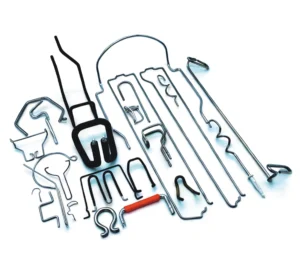
We make wire form clips, brackets, and complex 3D bent forms, from simple one-bend parts to multi-plane assemblies. Samples take 3–5 days and mass production typically takes 10–15 days, depending on quantity and complexity. For the full range of products, see our precision springs line.
Specifications & Capabilities
Our capabilities cover prototype and volume production, with process control designed to keep batches consistent.

Figure 2. Production floor at our Dongguan factory.
| Parameter | Capability |
|---|---|
| Wire diameter | 0.07 mm – 25 mm |
| Forming | Multi-axis CNC wire bending with programmed bend angles, 2D and 3D forming, multi-plane geometry, progressive dies and forming tools, laser spot welding for assemblies |
| Tolerances | Bending tolerances down to ±0.05 mm on multi-axis CNC equipment. Overall tolerances follow the drawing. Critical and non-critical dimensions are identified during engineering review, before quotation. |
| Materials |
Music wire and carbon steel (fatigue-critical clips) Oil-quenched and chromium silicon (valve grade) wire Hard drawn and hard drawn galvanized wire 302/304 and 17-7 PH stainless steel 316 / SUS316L stainless steel (washdown, medical, marine) Phosphor bronze, brass, beryllium copper Titanium, Inconel, Hastelloy, Monel, MP35N, Elgiloy |
| Material verification | Imported German material analysis spectrometer for element checks on raw wire, with batch traceability and material certificates (COA) supplied with each shipment |
| Heat treatment & stress relief | In-house heat treatment center, stress relieving, presetting |
| Surface treatment | Electroplating (including zinc-manganese), pre-galvanized wire, electropolishing for stainless steel, powder coating in any colour, electrophoretic coating (E-coat), hot-dip coating (black), passivation, ultrasonic deep cleaning |
| Secondary processes | Deburring, vibratory polishing, shot peening, load testing, grinding |
| Inspection equipment | Optical projectors, image-based dimensional measurement systems, CCD fully automated inspection machines, force and load testers, torque testers, salt spray test chambers, automated in-line force measurement and sorting for force-critical parts |
| Documentation | First article inspection report, in-process and outgoing inspection records, PPAP Level 3 package, CPK validation reports, material certificates (COA) and inspection reports with each shipment |
| Facility | 10,000+ m² production facility, 300+ pieces of production equipment, approximately 150 staff, based in Dongguan, Guangdong |
| Volume | Prototype through high-volume production |

Figure 3. Inspection and testing equipment in our quality laboratory.
For material properties and selection guidance, see our materials guide.
Production Process
Each order follows a controlled sequence, with inspection at the points where a defect would otherwise be expensive to find:
Order & Material
Order intake, material sourcing, incoming inspection (IQC)
Set-up
Material supply, machine adjustment, in-process inspection (IPQC)
First Article
First article inspection (FAI) before the run is released
Production
Forming with in-process inspection, heat treatment, IQC check
Finishing
Polishing, plating or coating, cleaning, IQC inspection
Release
Packaging, outgoing inspection (OQC), shipping
Figure 1. Six-stage production flow with inspection checkpoints.
For an overview of how we work with customers from inquiry to delivery, see Services & Capabilities.
Quality System
Our quality management is certified under IATF 16949 and ISO 9001, with certificates issued by SGS. We apply closed-loop quality control from raw material inspection through final shipment. For automotive programs, we provide the PPAP Level 3 package and CPK validation reports. Company background and certifications are described on our About Us page.
Lead Times and Order Terms
| Stage | Typical Lead Time / Volume |
|---|---|
| Samples | 3–5 days for standard parts |
| Trial orders | 100–500 pcs accepted to validate a design or market |
| Mass production | 10–15 days, depending on quantity and complexity |
| Custom tooling and sampling fee | Applies to custom-designed parts. Typically credited back after mass-production orders reach a set volume. |
| Incoterms | EXW, FOB, CIF, DDP and others. We ship to your designated port or warehouse. |
For a breakdown of what drives price, see our guide to how much custom metal clips cost, including price drivers, MOQ, and tooling.
Forms We Manufacture
We produce custom wire forms for the following functions:
- Clips & retention: retaining clips, snap-fit clips, latch forms, cotter pins, D-rings, duckbill clip springs
- Brackets & mounting: sensor brackets, wire brackets, guide wires, CPU and GPU retention brackets, EMI grounding clips, structural wire assemblies
- Handling & access: wire handles, bails, guards, levers, hydraulic retaining loops
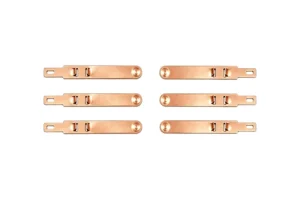
- Electrical / contact: contact springs, trip wires, precision contacts and terminals with gold plating where required
- Complex 3D forms: multi-plane bent wire forms that combine fastening, support, and spring action in one part
When a part combines wire forming with stamping or welding, we can also supply precision stamping components and precision welding assemblies as one package. If you are deciding between a clip and a retaining ring, our article on spring clips vs retaining rings compares how each holds up over time.
Industries served: AI servers and data centres, new energy vehicles, medical devices, robotics and automation, UAV and drone systems, new energy power and grid systems, high-end electronics, premium electrical appliances, aerospace, and high-end industrial equipment. For automotive applications, see our automotive spring solutions.
Technical Background
Our engineers hold a number of utility model and design patents covering spring and wire form design, including a connector spring clip and clamping structure, a multi-angle bendable composite spring for robot arms, a spring for automotive communication antennas, a deburring device for wire spring hooks, a long-tail duckbill clip spring, and a spring for medical needle insertion. These designs reflect the same engineering approach we apply to customer parts: fitting the geometry to the function and the load.
Why Design, RFQ, and Supplier Decisions Matter
Unlike catalog parts, the quality and cost of custom wire form springs depend heavily on decisions made before production. This is how we manage that risk.
1. Design review: the bend radius that was never calculated
Wire forms are often treated as bent structural parts, so fatigue is left out of the design. Bend radii are drawn to fit the geometry rather than the wire. A bend radius smaller than the wire diameter concentrates stress exactly where a cyclic load will find it. Our engineering review covers bend radius feasibility, stress at the bends, and tolerance strategy before a price is issued, which prevents field failures and batch fractures. For more on choosing clips for high-fatigue applications, see our guide.
2. RFQ gaps: how incomplete specs become a risk premium
Most RFQs arrive with missing information. Missing tolerances are priced as tight tolerances, and missing materials default to whatever is easiest to source. The quote looks like a price, but it is really a risk allowance. We identify these gaps before quoting, so the price reflects the real requirement.
3. Supplier selection: “Can you make this?” is the wrong question
Almost every manufacturer says it can make wire form springs. The better question is whether the supplier fits your geometry, your volume, and your quality requirements. Mismatches show up later, when batches drift or when the wire form does not interface correctly with its mating parts. We provide a process description along with the capability claim, so you can check the fit yourself. Our guide to evaluating custom spring clip suppliers sets out ten checks you can use for any supplier, including us.
4. Prototype to production: locking the process
A hand-made sample can match the drawing and still be impossible to repeat at volume. A sample proves that the shape can be made. It does not prove that it can be made repeatably. We treat prototype parts as the first units of the production batch, and we document the equipment, tooling, and process parameters alongside them, so the move to volume does not change the part.
Ready to Quote: What We Need
To provide an accurate quote, please include the following in your RFQ:
- Drawing / spec: a dimensioned drawing, physical sample, marked photo, or clear sketch.
- Material & finish: wire diameter, material (or let us recommend one based on the application), and finish requirements.
- Volume: prototype quantity and estimated annual usage.
- Environment: operating temperature, moisture or salt exposure, load cycles, and any applicable standards (for example, medical cleanliness requirements).
Send what you have. We will tell you what we need to close the gap.
Submit Your RFQ / Upload Drawing
Drawings can be uploaded through the form or sent by email. For confidential drawings, we recommend email, and we are happy to sign a mutual non-disclosure agreement (NDA) first. See the FAQ below for details.
Related Products and Guides
- Precision springs: the full range of custom spring types beyond wire forms
- Elastic structural components: structural parts that combine spring action with a load-bearing frame
- Which spring clips suit high-fatigue applications?
- How much do custom metal clips cost? Price drivers, MOQ and tooling
- Frequently asked questions: ordering, sampling, and shipping questions not covered here
FAQ About Custom Wire Form Springs
What are custom wire form springs?
Custom wire form springs are wire components cut and bent into a specific shape, such as clips, brackets, hooks, and guards, rather than coiled into a helix. They are made to a drawing, a sample, or an application requirement.
How do they differ from standard wire springs?
Standard wire springs are usually catalog items with predefined coil dimensions and load ratings. Custom wire form springs are designed for a specific mechanical or spatial problem, often combining fastening, support, and spring action in one bent component.
Can you start from a sample or photo instead of a CAD drawing?
Yes. A physical sample, marked photo, or written application description is a practical starting point. Our engineers can reverse-engineer a sample with precision measuring instruments and produce CAD drawings for your approval. We confirm the functional requirements first, and the formal drawing follows.
Is my drawing kept confidential?
Yes. We are glad to sign a mutual non-disclosure agreement before reviewing your drawings. Customer drawings and specifications are used only to quote and produce your parts, and they are returned or destroyed on request. For confidential drawings, we recommend sending them by email after the NDA is signed.
What wire diameter range can you produce?
From 0.07 mm to 25 mm.
How long do samples and production take?
Samples typically take 3–5 days for standard parts. Mass production typically takes 10–15 days, depending on quantity and complexity.
What is the minimum order quantity?
Large volumes reduce unit price, but we accept small trial orders, typically 100–500 pieces, to help you validate a design. For how MOQ affects cost, see our guide to custom metal clip pricing.
Which quality certifications do you hold?
IATF 16949 and ISO 9001, with certificates issued by SGS. Copies can be provided on request.