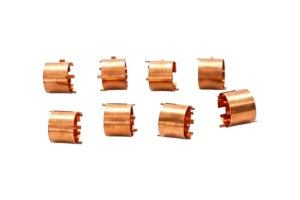
Why This Comparison Matters
Both spring clips and retaining rings are used to hold a part in place along a shaft or in a bore. They look like they do the same job, and on a drawing they often can. But over years of real service they behave very differently, and the wrong pick means a part that walks off or a ring that cracks. This comparison focuses on the one thing that matters most for long-term equipment: stability under load. For the moving-joint view, see our metal vs spring clip guide.
Table of Contents
- 1. What Each Part Actually Does
- 2. How They Hold Under Long-Term Load
- 3. Installation and Removal Differences
- 4. Failure Modes Over Time
- 5. Side-by-Side Reliability
- 6. When to Choose Which
1. What Each Part Actually Does
A retaining ring (circlip) is a near-rigid ring that sits in a machined groove and blocks axial movement. It holds by bearing against the groove shoulder. It has almost no give.
A spring clip used for retention adds elastic force. A snap ring or circular spring clip still sits in a groove, but it also pushes — so it keeps load on the assembly even as parts settle, heat, or wear. That small difference is the whole story for long-term stability.
2. How They Hold Under Long-Term Load
A plain retaining ring holds only as well as the groove and the shoulder behind it. If the assembly grows or shrinks with temperature, or the shouldered part wears, the ring can develop clearance and the retained part can shift. The ring itself does not compensate.
A spring clip compensates. Its preload follows the gap, so even if the stack height changes a little, the joint stays loaded. For a joint that must not drift over years, that active force is the more stable design. This is the same principle behind the spring clips chosen for high-fatigue duty.
3. Installation and Removal Differences
- Retaining ring. Needs pliers and a machined groove. Quick to fit, but the groove is a cost and a stress riser.
- Spring clip. Often snaps on by hand or with light tooling; some forms need no separate groove. Faster in high-mix assembly.
If your design already has a groove and a clear shoulder, a ring is simple. If you want to drop the groove or absorb stack-up, a spring clip earns its place.
4. Failure Modes Over Time
Retaining rings fail by groove deformation, by the ring being ejected if over-spun, or by corrosion at the shoulder. Spring clips fail mainly by fatigue at the bend or by stress relaxation if the alloy is wrong. Both are manageable — the ring’s risk sits in the mating part, the clip’s risk sits in its own material.
5. Side-by-Side Reliability
A reliability scorecard for long-term service:
| Factor | Retaining ring | Spring clip |
|---|---|---|
| Hold under stack-up change | Rigid, no compensation | Preload follows the gap |
| Needs machined groove | Yes | Often no |
| Long-term drift risk | Clearance can open | Lower (active force) |
| Main failure mode | Groove / ejection / corrosion | Fatigue / relaxation |
| Assembly speed | Tooled | Often hand-snap |
6. When to Choose Which
Choose a retaining ring when the joint is rigid by design, the groove already exists, and you want a cheap, proven part with no preload requirement. Choose a spring clip when the joint may shift with temperature or wear, when you want to skip the groove, or when assembly speed matters. In practice, spring clips win for long-term stability wherever the stack is not perfectly fixed.
Get a Quote
Send your shaft size, groove detail, and load and we will propose a ring or spring clip with samples. Start on our contact page, or use the live chat to talk to an engineer now.
FAQ
Is a spring clip just a flexible retaining ring?
Not quite. A retaining ring is rigid and bears on a groove; a spring clip adds elastic preload, so it keeps force on the joint as parts settle or heat.
Which is more reliable long term?
For a fixed, grooved joint, a ring is proven and cheap. Where the stack can change, a spring clip is more stable because its preload follows the gap.
Do spring clips need a machined groove?
Often no. Many snap-ring and circular spring clip forms seat on a shoulder or snap into a light recess, which can remove groove machining.
Can a spring clip replace a circlip?
In many axial-retention jobs, yes — especially where you want preload or want to avoid a stress-riser groove. Confirm load and deflection with samples.
What material resists relaxation best?
Beryllium copper and phosphor bronze hold preload far better than mild steel, which matters for a clip loaded for years.
Can you make custom spring clips to spec?
Yes. Send the shaft, groove, and load and we will propose the form, alloy, and finish, then build first-article samples.