Selecting the wrong rotary spring leads to insufficient torque, premature fatigue, and costly mechanical failures. The best choice depends on your rotational range: spiral springs provide continuous, smooth torque over long rotations using flat strips, while torsion springs deliver quick, angled return force using helical wire.
Partnering with an experienced custom spring manufacturer ensures your mechanism utilizes the correct energy storage solution, translating theoretical designs into highly reliable, mass-produced components.
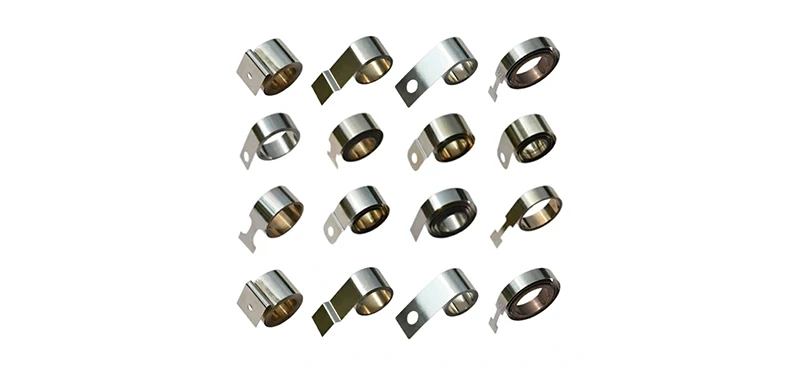
Table of Contents
- Why Choosing the Right Rotary Spring Defines Mechanical Reliability
- Structural Differences: Flat Strip vs. Helical Wire Mechanics
- Torque Performance and Rotational Range Capabilities
- Material Selection for Rotary Spring Applications
- How to Choose Between a Spiral Spring and a Torsion Spring
- Key Industry Applications for Rotary Spring Components
- Why OEM Engineers Rely on Custom Spring Manufacturers
1. Why Choosing the Right Rotary Spring Defines Mechanical Reliability
In mechanical design, engineers frequently face the challenge of selecting a component to manage rotational energy. Whether powering a medical device or returning a heavy industrial lever, the underlying spring mechanism must be flawless.
Choosing between a spiral spring and a torsion spring dictates how a mechanism stores, releases, and controls rotational energy. An incorrect specification results in uneven load distribution, unpredictable motion, and reduced service life.
For OEM buyers and product designers, purchasing standard off-the-shelf springs often leads to a mismatch between the spring’s capability and the assembly’s spatial footprint. A spiral spring and a torsion spring both generate torque, but they handle mechanical stress entirely differently. Relying on a manufacturer that can provide a custom spring solution ensures that critical parameters—such as the required torque output, available installation space, rotation angle, and operating cycles—are precisely calculated to prevent issues like relaxation (loss of force) or sudden fatigue snapping under dynamic loads.
2. Structural Differences: Flat Strip vs. Helical Wire Mechanics
At a fundamental engineering level, these two spring types operate on entirely different structural paradigms, which dictates their physical footprint and integration into mechanical assemblies.
A spiral spring is wound from a flat strip of material to store energy in a compact cylindrical housing, whereas a torsion spring is formed from round wire to generate torque through the twisting deformation of its coils and extending legs.
A custom spiral spring (frequently referred to as a clockwork spring, power spring, or constant force spring depending on its exact configuration) consists of a rectangular metal strip wound into a tight spiral. The inner end is usually secured to a rotating arbor (shaft), while the outer end is anchored to a stationary housing. As the arbor turns, the strip winds tighter, storing vast amounts of rotational energy in a highly compact, flat radial space.
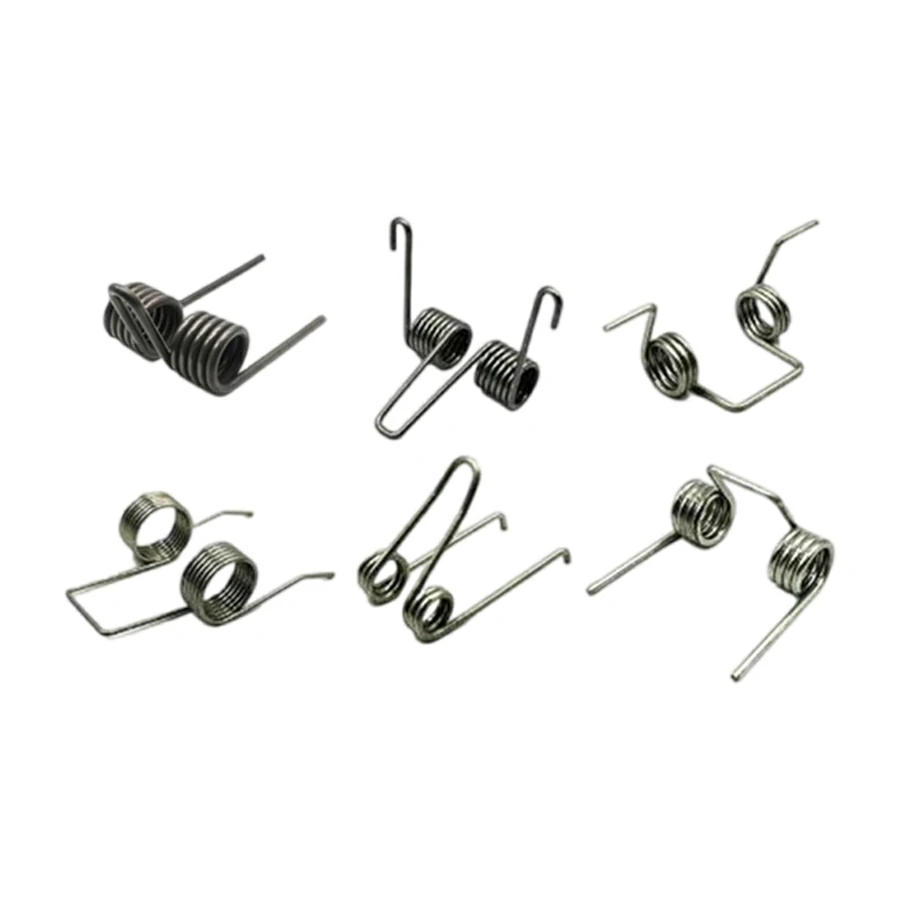
Conversely, a custom torsion spring features a helical coil structure made from round (or sometimes square) wire. It possesses extending “legs” on both ends. One leg is fixed, while the other is subjected to a radial force, causing the coil body to twist tighter. This requires distinct spatial considerations, as the spring body will decrease in diameter and increase in length during actuation.
Comparison of Spiral and Torsion Springs
| Feature | Spiral Spring | Torsion Spring |
| Material Form | Flat strip material | Round or square wire material |
| Working Principle | Stores energy through winding and unwinding | Generates torque through twisting deformation |
| Output Type | Continuous, smooth rotational torque | Rapid return torque within a defined angle |
| Motion Type | Rotary energy storage and sustained release | Rotational resistance and quick recovery |
| Installation Profile | Compact cylindrical housing (radial footprint) | Requires lateral space for coil expansion and spring arms |
| Design Focus | Torque consistency and maximum energy capacity | Torque angle, leg configuration, and immediate return force |
3. Torque Performance and Rotational Range Capabilities
The way force is delivered over a specific mechanical distance ultimately separates these two components.
Spiral springs excel in delivering smooth, continuous torque over multiple 360-degree rotations, while torsion springs provide immediate, high-resistance return force restricted to a defined, limited operating angle.
Understanding the torque curve of each spring type is paramount for proper spiral spring design and torsion spring design.
Spiral Spring: Continuous Torque and Long Travel
A spiral spring is specifically designed to manage long rotational travels. When properly engineered, it can output a relatively flat torque curve, meaning the force it exerts remains remarkably consistent whether it has been unspooled one rotation or five.
Important design factors for spiral springs include the spring strip thickness, material width, coil diameter, and the number of active turns. Increasing the thickness of the flat strip increases the torque exponentially, while increasing the width increases it linearly. The primary advantage here is energy density; spiral springs store and release rotational energy highly efficiently, making them indispensable for mechanisms requiring sustained pulling or retracting force over a long distance.
Torsion Spring: Immediate Return Force and Short Angles
A torsion spring provides a steeply climbing torque curve. The further you push the leg, the harder it resists. It is generally not designed for multi-turn applications; instead, it operates best within a limited operating angle (typically between 30 and 180 degrees, though custom designs can exceed this slightly).
Important design factors include the wire diameter, number of coils, leg length, and required operating angle. When a torsion spring actuates, bending stress concentrates heavily on the legs and the transition radius into the coil body. Therefore, the torsion spring design must strictly account for the maximum yield strength of the material to prevent the legs from snapping under high-cycle, repetitive use.
4. Material Selection for Rotary Spring Applications
Even the most perfectly calculated geometric design will fail catastrophically if the material yields under operational stress or succumbs to environmental degradation.
Material selection for both spiral and torsion springs directly affects fatigue resistance, elastic recovery, and service life, with carbon steel offering high strength and stainless steel providing essential corrosion resistance.
Material selection affects how a spring behaves under dynamic load. Both spiral and torsion springs are subjected to intense bending stresses.
- Carbon Steel and Alloy Spring Steel: For applications in controlled environments requiring extremely high cycle life and massive force, high-carbon steel or alloy spring steels (like Chrome Silicon) are heavily favored. They offer exceptional fatigue limits and elastic recovery, ensuring the spring does not permanently deform after thousands of actuations.
- Stainless Steel: For applications requiring long-term reliability in harsh, humid, or chemically exposed environments, stainless steel is mandatory. While austenitic stainless steels (like 302 or 304) have slightly lower tensile strength than carbon steel, their inherent resistance to oxidation prevents microscopic corrosion pits—which act as deadly stress risers that cause sudden fatigue failure.
An experienced spiral spring manufacturer provides critical material selection support, matching the metallurgy exactly to your required load consistency and environmental conditions.
5. How to Choose Between a Spiral Spring and a Torsion Spring?
Making the final engineering decision requires aligning mechanical output requirements with the strict spatial constraints of the OEM assembly.
Choose a spiral spring for continuous torque output and compact energy storage over long rotational travels. Choose a torsion spring for quick rotational returns, simple mechanical movements, and cost-effective force within limited angles.
When evaluating spiral spring vs torsion spring, consider the following decision framework:
Choose a Spiral Spring When Your Application Requires:
- Continuous torque output: You need the force to remain smooth and steady over a long distance.
- Compact energy storage: The spring must fit inside a flat, radial housing.
- Long rotational travel: The mechanism requires multiple full rotations (e.g., pulling out a long cable).
- Smooth force release: The retraction must be controlled and uniform.
Choose a Torsion Spring When Your Application Requires:
- Quick rotational return: You need a lever or hinge to snap back to its original position immediately.
- Simple mechanical movement: The action is a simple opening/closing mechanism.
- Limited rotation angle: The movement is confined to a fraction of a circle (e.g., 90 degrees).
- Flexible installation options: You have the lateral space to accommodate extending spring legs.
6. Key Industry Applications for Rotary Spring Components
Different industries subject these rotary springs to vastly different stress profiles, dictating highly specific custom spring solutions.
Automotive systems utilize custom spiral springs for long-travel seatbelt retractors and torsion springs for durable hinges, while precision equipment relies on spiral springs for highly exact timing mechanisms.
Automotive and Industrial Equipment
The automotive sector demands supreme reliability. Spiral spring applications dominate seat belt retractors, where a long, smooth pull is required, alongside energy return systems in advanced seating. Their compact installation design is critical for modern, space-constrained vehicle interiors. Conversely, torsion spring applications are universally found in vehicle covers, trunk hinges, pedal returns, and mechanical latches, where a strong, immediate return force is necessary.
In heavy industrial equipment, spiral springs serve as rotary energy storage for automatic return mechanisms in heavy cabling or hose reels. Torsion springs manage mechanical positioning and absorb shock in repeated opening and closing actions on factory floors.
Precision and Consumer Electronics
Precision equipment—such as medical diagnostic devices and high-end timing mechanisms—requires springs with exact force characteristics. Custom spiral springs are engineered to provide highly stable torque and high repeatability, ensuring delicate rotary control systems operate flawlessly over millions of cycles. In consumer electronics, custom spring solutions help manufacturers achieve a smaller assembly size without sacrificing reliable motion control, tailoring the spring geometry perfectly to the limited internal housing.
Aerospace and Defense
Aerospace and defense systems subject rotary springs to extreme temperature swings, high vibration, and mission-critical reliability demands. Spiral springs drive long-travel actuation in flight-control mechanisms and satellite antenna deployment, while torsion springs return canopy handles, access panels, and utility doors. Because aerospace springs must hold precise torque after years of standby and thermal cycling, manufacturers specify high-temperature alloys (such as Inconel or precipitation-hardened stainless) and validate every batch to strict aerospace quality standards.
7. Why OEM Engineers Rely on Custom Spring Manufacturers
Purchasing generic rotary springs introduces immense risk into high-value mechanical assemblies, as slight deviations in torque output or dimensions can jam an entire mechanism.
A professional custom spring manufacturer provides expert engineering support, material selection, and precision manufacturing, ensuring the rotary spring matches the exact torque, spatial, and lifecycle requirements of the OEM application.
The debate of spiral spring vs torsion spring is rarely a question of which is universally better; it is a question of which solves your specific mechanical challenge.
At Guangdong Hershey Spring Industrial Co., Ltd. (Hershey), we understand that OEM buyers need more than just standard components; they need comprehensive performance optimization. By working with our engineering team, you gain access to customized spiral spring design and torsion spring design services. We evaluate your required operating cycles, load consistency, and application environment to eliminate problems like insufficient torque or premature fatigue.
With advanced capabilities spanning from rapid prototyping to full OEM mass production, Hershey guarantees precision manufacturing that delivers dimensional accuracy and unwavering batch consistency.
Conclusion
Both spiral springs and torsion springs are indispensable mechanisms for managing rotational energy, but they serve distinctly different structural purposes. Spiral springs offer superior energy density and smooth, continuous torque for long-travel mechanisms like retractors and reels. Torsion springs provide highly efficient, robust return forces for angled operations like hinges and switches. Choosing the optimal component requires a rigorous technical evaluation of your assembly’s spatial limitations, torque requirements, and environmental exposure.
For compact axial-load applications, also explore our custom wave springs, engineered for tight radial spaces where a spiral or torsion spring is not ideal.
Are you facing a complex design challenge with your rotary mechanisms?
Do not rely on trial and error with standard components. Contact Guangdong Hershey Spring Industrial Co., Ltd. today. Send us your CAD drawings or operational specifications, and our engineering team will provide expert spring selection advice, custom prototype development, and a competitive quotation for OEM mass production.
Frequently Asked Questions (FAQ)
What is the main difference between a spiral spring and a torsion spring?
The main difference lies in their structure and motion. A spiral spring is made from a flat metal strip wound into a flat coil, providing continuous torque over multiple rotations. A torsion spring is made from helical wire, providing high-resistance return torque over a limited, short rotational angle.
When should I choose a custom spiral spring over a standard one?
You should choose a custom spiral spring when your application has unique housing constraints, requires a highly specific flat torque curve, or operates in a severe environment that mandates specialized material selection beyond standard catalog options.
How does wire diameter affect torsion spring design?
The wire diameter has an exponential effect on the stiffness and torque output of a torsion spring. A slight increase in wire thickness dramatically increases the force required to twist the spring, while a decrease makes the spring highly flexible.
Which spring is better for high-cycle rotary applications?
Both can be optimized for high-cycle use, provided the operating stress remains below the material’s fatigue limit. However, torsion springs are often preferred for rapid, short-angle, repetitive actuations, while spiral springs are better for smooth, long-duration energy releases.
Can a torsion spring rotate a full 360 degrees?
Generally, standard torsion springs are designed for angular deflections under 360 degrees (often 90 to 180 degrees). Pushing a standard torsion spring beyond its designed operating angle will overstress the legs and cause permanent deformation or snapping. Multi-turn applications require a spiral spring.
How do custom spring manufacturers ensure torque consistency?
Reliable manufacturers ensure torque consistency through precision CNC forming, strict material quality control, and in-line dynamic load testing. They carefully monitor the spring index and perform stress-relieving heat treatments to guarantee every batch performs identically.