CNC machining materials are the metals and plastics a subtractive process can cut to final tolerance. The grade you name sets two things before a single toolpath exists: whether the part can be made at all, and what the machine time will cost.
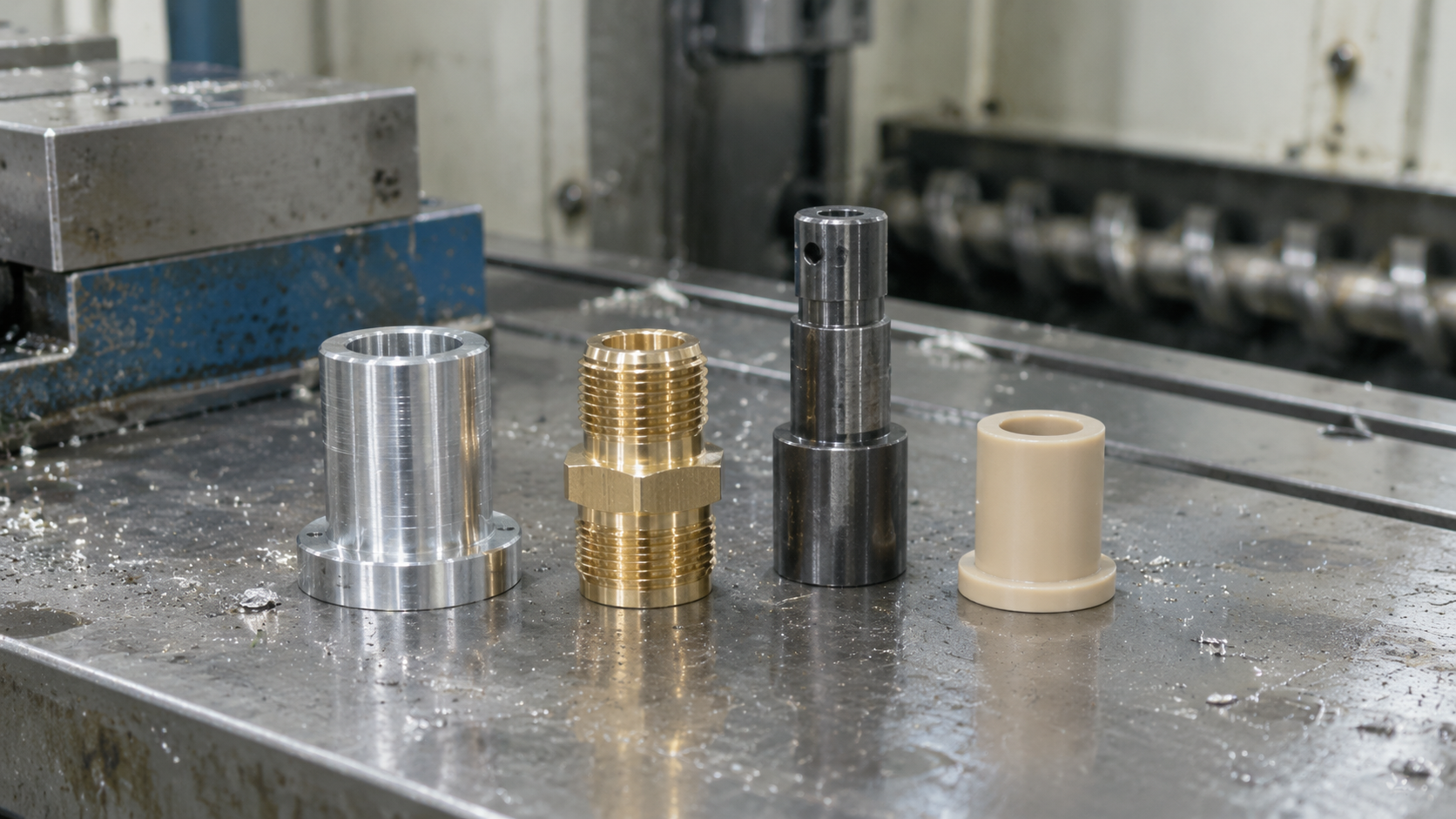
This page compares the families a job shop actually stocks and cuts. It filters — it does not rank. There is no best material, only the one that satisfies your function at the lowest total cost.
How to Use This List
Work through three filters in order. The first one eliminates most of the list on its own.
Filter 1 — Function. Corrosion exposure, operating temperature, electrical or thermal conductivity, weight, and whether the part carries load. Get this wrong and nothing later saves you.
Filter 2 — Machinability. This is the filter buyers skip. A grade that costs more per kilogram but cuts twice as fast is often the cheaper part. Machinability sets cycle time, tool wear and how many setups you need.
Filter 3 — Stock and lead time. A grade that exists in a catalog but not in the size you need will add weeks. Ask what is on the shelf before you finalize the drawing.
Stock questions usually go to a supplier rather than a website, so it is worth knowing which customer specification questions we answer before quoting.
Aluminum Alloys
6061 is the default for machined parts, and for good reason: it cuts easily, holds tolerance, welds, and anodizes predictably. Choose it for housings, fixtures, brackets, manifolds and heat sinks. Avoid it where the surface must resist wear or abrasion — aluminum has no hardness to spare, and an anodized layer will not carry a loaded contact.
7075 gives you significantly higher strength in the same envelope, which is why aerospace and mold work use it. It machines well but is less forgiving than 6061, and its corrosion resistance is poorer — an uncoated 7075 part in a wet environment is a bad decision. Weldability is also limited.
2024 is a high-strength alloy with genuinely poor corrosion resistance; it is normally supplied clad and still wants a protective finish. Reserve it for load-critical airframe and structural work where strength governs and the environment is controlled.
5083 is a marine-grade, weldable, formable alloy. It is not the right choice for tight-tolerance machining — it is gummy and better suited to formed and welded fabrications than to precision cut parts.
Stainless Steels
303 is the free-machining grade, and the difference is not subtle: it is the only stainless most shops will quote without adding a surcharge for difficulty. Use it for high-volume turned parts, fittings and fasteners. Avoid it for welded assemblies, and check it against food or marine requirements — the additives that make it cut well are the reason it underperforms there.
304 and 304L are the general-purpose austenitic grades. Good corrosion resistance, good formability, widely available. They work-harden under the tool, so a shop that takes too light a pass will glaze the surface and then fight it for the rest of the part.
316L adds molybdenum, which buys chloride resistance. This is the grade for marine, pharmaceutical, food-processing and medical hardware. It is also harder to machine than 304, work-hardens faster, and is where inexperienced suppliers underestimate cycle time most often.
17-4PH is a precipitation-hardening grade: machine it in the annealed condition, then age it to final strength. You get high strength with stainless corrosion resistance, at the cost of a second thermal operation and a tighter machining window. Use it for shafts, valves and high-stress components.
Carbon and Alloy Steels
1045 is the medium-carbon workhorse for shafts, pins and general machinery parts. It machines at a moderate rate, can be induction hardened after cutting, and is cheap. If the part needs a hard surface and a tough core, this is usually the starting point.
4140 is chrome-moly and the standard for parts that will be quenched and tempered. High strength, good fatigue behavior, widely stocked. It machines less freely than 1045 and is normally supplied annealed for cutting.
4340 is the choice for thick sections and high shock loading, where 4140 would not give enough toughness through the section. Expect slower cutting and more tool wear.
12L14 is a leaded free-machining steel — the fastest-cutting steel on this list, which makes it attractive for high-volume small parts. Two cautions: it is not for welded assemblies, and leaded grades face restricted-substance scrutiny in some markets, so confirm against your customer’s substance list before committing.
Copper Alloys
C360 free-cutting brass machines more easily than any other common metal, which makes it the cheapest per part for small fittings, connectors, valve bodies and decorative hardware. It also has good electrical and thermal conductivity. Avoid it under sustained load, and be careful with ammonia-bearing environments — brass is susceptible to stress-corrosion cracking there.
C110 copper is the conductivity grade: busbars, electrodes, thermal straps. It is gummy and difficult to break a chip in, so it machines slowly and tends to tear rather than cut cleanly. Choose it when conductivity is the requirement, not when machinability is.
Bronze and bearing bronzes are for wear surfaces, bushings and worm wheels. They tolerate poor lubrication and embed grit rather than scoring the mating surface.
Titanium Alloys
Grade 2 is commercially pure titanium: excellent corrosion resistance in chemical, marine and medical service, moderate strength. It machines better than the alloyed grades but still slower than stainless.
Grade 5 (Ti-6Al-4V) is the high-strength alloy used in aerospace and implants. It is genuinely difficult to machine, and for reasons that are structural rather than cosmetic: it work-hardens, and its low thermal conductivity keeps heat at the cutting edge instead of letting it leave with the chip. That combination destroys tools quickly. It demands rigid setups, sharp tooling, generous coolant and a shop that has cut it before.
Avoid titanium when cost is the governing constraint or when the part is large and simple — you will pay a large premium for properties the application does not use.
Engineering Plastics: POM, PEEK and the Rest
Plastics are not a cheap substitute for metal. They fail differently: creep under sustained load, dimensional change from moisture, and higher thermal expansion than any metal on this list. Judge them on those terms, not on strength alone.
POM (acetal) CNC machining
POM — widely known by the trade name Delrin — is the best general-purpose engineering plastic for machining. It is dimensionally stable, has low friction, cuts cleanly and holds tight tolerance far better than most plastics. That combination makes it the standard for gears, bushings, rollers, fixtures and food-handling components.
Choose POM for mechanical parts that need to slide or mesh without lubrication. Avoid it in strong acids and oxidizing agents, and do not specify it where the service temperature approaches its softening range — above that point the part creeps rather than fails visibly, which is worse.
PEEK CNC machining
PEEK is the high-performance end of the range, and the price reflects it. It holds mechanical properties at temperatures where POM and nylon have already softened, resists a broad range of chemicals, and is available in grades acceptable for medical and semiconductor use. That is why it appears in wafer-handling components, implant trials, aerospace brackets and downhole parts.
Machining PEEK is not difficult in the way titanium is; the difficulty is process control. It is abrasive to tooling in its glass- or carbon-filled forms, it needs sharp edges and free-cutting conditions to avoid a gummy finish, and it benefits from stress relief before final machining if you need to hold tight tolerance on a thick section. Avoid PEEK only when cost governs — for a simple bracket at room temperature, you are paying for properties you will never use.
Other common plastics
ABS is cheap, machines easily and is used for prototypes and enclosures where appearance matters more than strength. PC (polycarbonate) adds impact resistance and optical clarity. PA / nylon gives wear resistance and toughness but absorbs moisture, so dimensions move after machining and it is a poor choice for tight-tolerance parts. PTFE is chemically inert and has the lowest friction available, but it creeps badly under load. PEI (Ultem) sits between PC and PEEK: good strength and thermal resistance at a fraction of PEEK’s cost.
When the Grade Changes the Process
Material choice is not only a properties decision — it changes how the part must be made. Four effects matter more than the rest.
Work hardening. Stainless and titanium harden under the cutter. A pass that is too light rubs instead of cutting, and the surface gets harder with every subsequent pass. Shops that are used to aluminum have to change the whole approach here.
Heat at the edge. Titanium and, to a lesser degree, stainless conduct heat poorly, so the heat stays in the tool. Tool life collapses before the part shows any problem, which is why these grades need different speeds, feeds and coolant strategy.
Wall thickness. The stiffness of the material decides how thin a wall you can hold. A feature that is routine in aluminum may be unmakeable in a soft plastic, and a wall that vibrates in titanium will not hold tolerance at all.
Post-machining movement. Plastics release internal stress and absorb moisture. If the part needs to hold tolerance weeks later, specify stress-relieved stock and agree on a stabilization step.
Surface Treatment: When the Coating Changes the Answer
Surface treatment sits downstream of material choice, and it can overturn the decision you just made. Three effects matter.
It can rescue a cheaper grade. A carbon steel part with the right coating may outperform an uncoated stainless part in a specific environment, at lower cost. That is legitimate engineering, not a shortcut — but it moves the risk from the material to the coating, and coatings fail in ways metal does not.
It costs you tolerance. Plating and anodizing build a layer on the surface. A tight-tolerance part must be machined undersize to allow for it, and the shop has to know the final coating before it cuts. A drawing that calls for a close tolerance and a plated finish, without stating the pre-plate dimension, is an invitation to a rejected lot.
It changes the process route. Anodizing is primarily an aluminum process, with variants for titanium and magnesium. Passivation is a stainless step: it removes free iron from the surface and restores the oxide layer, which is why a machined 316L part is normally passivated after cutting. Electroless nickel, zinc plating and powder coating cover the steels. Hard anodizing adds a wear resistance the aluminum base never had.
Plastics follow a different logic. Anodizing and passivation do not apply to them, and the step that matters is stress relief — the plastic equivalent of a stress-relief cycle on metal, used to stop dimensions moving after machining. Plating does exist for plastics, with ABS the common case, but there it is a decorative and shielding process rather than corrosion control. If a plastic part must hold tolerance weeks into service, specify the stabilization step at the quoting stage.
Material Comparison at a Glance
| Material family | Common grades | Machinability | Use it when | Avoid it when |
|---|---|---|---|---|
| Aluminum | 6061, 7075, 2024, 5083 | Easy | Weight, conductivity, anodized finish, prototypes | Wear surfaces, high load at temperature |
| Stainless steel | 303, 304/304L, 316L, 17-4PH | Difficult | Corrosion, hygiene, medical, food contact | Cost-driven volumes, thin walls |
| Carbon and alloy steel | 1045, 4140, 4340, 12L14 | Moderate | Structure, shafts, parts to be hardened | Uncoated wet service, weight-critical parts |
| Copper alloys | C360 brass, C110 copper, bronze | Easy | Electrical and thermal paths, small fittings | High mechanical load, ammonia exposure |
| Titanium | Grade 2, Grade 5 (Ti-6Al-4V) | Difficult | Strength-to-weight, biocompatibility, aggressive chemicals | Cost-governed parts, large simple shapes |
| Engineering plastics | POM, PEEK, ABS, PC, PA, PTFE, PEI | Easy to moderate | Insulation, low weight, self-lubrication, chemical resistance | Sustained load, elevated temperature, tight tolerance over time |
A PDF material chart will give you tensile strength and hardness for every grade. Those numbers are widely published and easy to look up. What a chart will not tell you is which of these families your application should never have been using in the first place — and that is the decision this page is trying to help you make.
What Material Does to Your Quote
Material affects price through four channels, and only one of them is the price of the material itself.
Cycle time. The largest lever. Machinability sets how fast the tool can move, so a difficult grade can multiply machining time even though the blank cost is a small share of the part.
Setup count. Harder materials need more conservative fixturing and often more operations to reach the same tolerance, because you cannot take the aggressive passes that work in aluminum.
Tool consumption. Titanium, stainless and glass-filled plastics wear tooling faster. This is a real cost line, and it is invisible in the material price list.
Post-processing. Anodizing, passivation, plating, heat treatment and stress relief all attach to specific grades. A material that avoids a finishing step is often cheaper overall than the one with the lower stock price.
This is why comparing quotes at the material-price level tells you nothing. The same drawing in 6061 and in 316L differs far more from cycle time and tool wear than from the price of the billet. If you want the wider cost picture — process route, tolerances, quoting structure — start with how CNC machining works and what drives its cost, then check what our machines can actually hold.
Where to Go Deeper
- CNC machining basics: process, axes, operations and cost drivers — the full background to this page.
- Our machining capabilities and equipment — sizes, tolerances, materials and finishing under one roof.
- Send a drawing for material review — we will come back with grade, route and reason.
Frequently Asked Questions
What is the real difference between machining aluminum and stainless steel?
Aluminum cuts fast, costs little per part, and takes anodizing. Stainless cuts slowly, work-hardens under the tool, and is specified for corrosion and hygiene. The decision is rarely about strength — it is about the service environment, and then about cycle time, which is where stainless gets expensive.
How do I choose between 4130 and 4140 for a machined part?
Both are chrome-moly. 4130 carries less carbon, so it welds readily and forms well; 4140 carries more, responds better to quenching and tempering, and is the usual choice where you need hardness through the section. If the part gets welded, start at 4130. If it gets heat treated for strength, start at 4140.
When does a part actually need Inconel or Hastelloy instead of stainless steel?
When the condition is beyond what austenitic stainless can hold: strength retained at high temperature, or aggressive chloride and acid service where 316L pits. Both are slow to machine and expensive, so the justification has to be a service condition stainless genuinely fails — not a safety margin added to the drawing.
Does material choice affect lead time and cost?
Both, through different channels. Lead time depends on whether the grade and the size are in stock; an unusual alloy in an unusual size can add weeks. Cost depends mostly on cycle time, tool wear and setup count rather than the price of the blank — a harder grade often costs more to machine than to buy.
Do I need to specify the grade, or just the material family?
Specify the grade. “Stainless steel” can mean 303 or 316L, and the difference changes corrosion performance, machinability and price. “Aluminum” can mean 6061 or 7075, which differ in strength and corrosion resistance. A shop quoting from a family name is quoting an assumption.
For a high-temperature part, how do I choose between PEEK and a metal?
Fix the actual service temperature and the required life first. Below the engineering-plastic ceiling, PEEK and PEI are the practical answers and they avoid the weight and corrosion problems of metal. Above it, you are in stainless or titanium, and the question becomes which alloy holds its strength at that temperature.
Summary
- Filter on function first. Corrosion, temperature, conductivity and load eliminate most of the list before machining is even a question.
- Then filter on machinability. A harder-to-cut grade raises cycle time, tool wear and setup count — often more than the material price difference.
- Check stock before you finalize. A grade in the catalog but not in your size adds weeks to the lead time.
- Name the grade, not the family. 303 is not 316L, and 6061 is not 7075. Vagueness gets quoted as an assumption.
- For plastics, judge creep and movement, not strength. That is how they actually fail.
- Expect a process change with titanium and stainless. Work hardening and heat at the edge mean different speeds, feeds and tooling — not just a different blank.
- Decide the coating before the drawing is released. Plating and anodizing change the machined dimension, and a pre-plate size left unstated is a rejected lot waiting to happen.
Not sure which grade fits your part?
Send the drawing and the operating conditions. We will come back with the grade, the process route and the reason behind both.