When a flat spring fails prematurely, the root cause is rarely a simple material defect. The performance and lifespan of a flat spring are directly determined by the precise combination of material selection, stress distribution in the design, manufacturing edge quality, and environmental resistance. Optimizing these factors guarantees mechanical reliability.
Moving beyond standard off-the-shelf components, high-value OEM assemblies demand a rigorous engineering approach. Relying on an experienced custom flat spring manufacturer ensures that these critical components are optimized for your exact operational envelope, preventing costly assembly line halts and field failures.
Table of Contents
- Why Proper Flat Spring Design Prevents Early Fatigue Failure
- How Material Selection Impacts Flat Spring Lifespan
- Core Flat Spring Design Parameters and Stress Distribution
- The Role of Manufacturing Precision and Edge Quality
- How the Working Environment Influences Flat Spring Durability
- High-Cycle Applications Utilizing Custom Flat Springs
- How a Flat Spring Manufacturer Ensures OEM Quality
1. Why Proper Flat Spring Design Prevents Early Fatigue Failure
Flat springs are integral to modern mechanical assemblies because they offer unmatched design flexibility in severely constrained spaces where traditional coil springs simply cannot fit. However, this compact nature makes them highly susceptible to dynamic fatigue if not engineered properly.
A custom flat spring fails prematurely when internal stresses exceed the material’s fatigue limit. By partnering with a precision flat spring manufacturer to optimize stress distribution and eliminate micro-cracks during production, engineers can drastically improve flat spring performance and ensure a long service life.
Unlike compression springs that absorb load linearly along a central axis, flat springs often function as cantilever beams or complex bending structures. When a flat spring deflects, the material undergoes both tension (on the outer convex curve) and compression (on the inner concave curve). If the spring design forces the component to deflect beyond its elastic limit, the metal will suffer permanent plastic deformation. This results in a “relaxed” spring that no longer provides the required contact pressure or return force.
In continuous, high-cycle applications, even if the deflection remains within the elastic limit, the component can still fail due to fatigue. Fatigue failure originates at points of localized stress—often at sharp bends, mounting holes, or imperfect edges. A professional flat spring design meticulously calculates the load requirements and deflection range to ensure the operating stress remains well below the material’s endurance limit, thereby guaranteeing millions of flawless operating cycles.
2. How Material Selection Impacts Flat Spring Lifespan
Specifying the correct alloy is the foundational step in custom spring solution development. A beautifully designed flat spring will still fail rapidly if the metallurgy does not align with the physical demands of the application.
Material selection dictates the fundamental mechanical limits of a flat spring. Carbon steel provides cost-effective strength, alloy spring steel offers maximum fatigue resistance, stainless steel resists environmental corrosion, and copper alloys ensure optimal electrical conductivity.
A qualified flat spring manufacturer does not expect OEM buyers to guess which material is best; they provide authoritative material selection support based on the specific load frequency and environmental exposure. For instance, high-carbon steel offers an exceptional strength-to-weight ratio and is highly cost-effective, making it ideal for enclosed, heavy-duty mechanical actuators. However, carbon steel is highly vulnerable to oxidation and requires secondary surface plating.
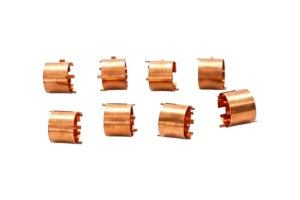
If the flat wire spring must operate in a highly corrosive environment—such as a medical sterilization chamber or an automotive exterior—stainless steel grades (like 301, 304, or 17-7 PH) are strictly required to prevent rapid rust degradation. For electrical applications, such as battery contacts or grounding clips, beryllium copper or phosphor bronze are utilized to balance mechanical elasticity with superior electrical conductivity.
Flat Spring Material Performance Comparison
| Material Grade | Key Advantages | Typical Industry Application | Corrosion Resistance | Relative Fatigue Life |
| High Carbon Steel (e.g., 1074, 1095) | High tensile strength, very cost-efficient. | Industrial equipment, internal automotive mechanisms. | Low (Requires plating) | Good |
| Alloy Spring Steel (e.g., 5160) | Superior shock absorption, high yield strength. | Heavy-duty machinery, high-stress custom flat springs. | Low (Requires plating) | Excellent |
| Stainless Steel (301 / 17-7 PH) | Inherent rust resistance, stable at extreme temps. | Medical devices, outdoor EV components, aerospace. | High | Very Good |
| Beryllium Copper / Phosphor Bronze | Excellent electrical conductivity, non-magnetic. | Electronic equipment, battery contacts, sensor clips. | High | Good |
3. Core Flat Spring Design Parameters and Stress Distribution
A flat spring is rarely just a straight piece of metal; it features complex bends, varying widths, and specific mounting holes that all influence how mechanical load is absorbed and dispersed.
Essential flat spring design parameters include material thickness, active length, spring width, and mounting geometry. Incorrectly configuring these dimensions creates localized stress concentrations that rapidly accelerate metal fatigue and cause catastrophic component failure.
When engineers ask how to improve flat spring performance, the answer almost always lies in optimizing the geometry to achieve uniform stress distribution.
Thickness, Width, and Deflection Ratios
The thickness of a flat spring has an exponential impact on its stiffness and load-bearing capacity. According to fundamental engineering principles, doubling the thickness of a flat spring increases its stiffness by a factor of eight. Therefore, specifying an excessively thick material to achieve a higher force can inadvertently make the spring too rigid, causing it to snap rather than flex. Conversely, adjusting the width of the flat spring provides a linear increase in force without drastically altering the stress profile. Expert designers manipulate the width-to-thickness ratio to achieve the exact deflection range required within the available installation space.
Mounting Methods and Stress Risers
How a flat spring is anchored within the assembly is just as critical as its free geometry. If a custom flat spring for high cycle applications is clamped too rigidly with sharp-edged fixtures, the clamping point becomes a massive stress riser. During continuous vibration or repeated deflection, the metal will eventually shear directly at this mounting line. Professional designs incorporate radiused mounting clamps, tapered spring widths, and strategically placed relief holes to distribute the operational stress across the entire active length of the component, dramatically extending its service lifespan.
4. The Role of Manufacturing Precision and Edge Quality
Even a perfectly engineered CAD model will fail in the real world if the manufacturing process introduces microscopic flaws into the metal strip.
High manufacturing precision prevents premature failure by ensuring dimensional accuracy and flawless edge quality. Imperfect stamping processes leave microscopic burrs and micro-fractures along the spring edges, which act as stress risers that quickly propagate into complete fatigue cracks.
Transforming raw strip material into a precision flat spring requires highly controlled stamping, forming, and heat-treating processes. When a mechanical press shears the metal, it naturally creates a small burr along the edge. If the tooling is dull or improperly calibrated, this shearing action also introduces micro-fractures into the crystalline structure of the steel. Because the edges of a flat spring endure the highest tensile stress during bending, these microscopic imperfections act as exact starting points for fatigue cracks.
Precision Forming and Grain Direction
A highly experienced flat spring manufacturer understands the critical importance of material grain direction. Strip steel has a distinct grain structure created during the cold-rolling process. If a flat spring is bent parallel to this grain, the metal is highly susceptible to cracking. Precision manufacturing ensures that the primary bends are oriented perpendicular to the grain direction, maximizing the structural integrity of the spring.
Surface Finish and Heat Treatment
To guarantee long-term stability, precision flat springs undergo advanced surface treatments. Processes such as vibratory tumbling or shot peening are utilized to remove edge burrs and induce beneficial compressive stresses on the surface, directly counteracting the tensile stresses that cause fatigue. Furthermore, proper heat treatment (such as austempering or stress-relieving) is mandatory to lock in the desired mechanical properties, ensuring the flat wire spring maintains consistent elasticity over millions of cycles.
5. How the Working Environment Influences Flat Spring Durability
An OEM component must survive the actual physical realities of its deployment, which often involve aggressive thermal and chemical exposures that rapidly degrade mechanical performance.
Environmental factors severely degrade flat spring lifespan through thermal relaxation and chemical oxidation. Continuous high-frequency vibration, extreme temperature fluctuations, and corrosive ambient humidity require highly customized material and surface coating solutions to maintain stable elasticity.
Understanding the working environment is paramount when defining flat spring design considerations.
Thermal Relaxation and High Temperatures
When a flat spring is subjected to elevated temperatures while under load, it experiences a phenomenon known as thermal relaxation. The atomic structure of the metal slowly shifts, causing the spring to permanently lose a percentage of its initial return force. For applications operating near engines or industrial furnaces, standard carbon steel is inadequate. Engineers must specify high-temperature alloys like 17-7 PH stainless steel or Inconel to ensure the spring force remains stable despite severe heat exposure.
Dynamic Vibration and Corrosive Environments
In applications such as automotive suspensions or outdoor EV charging ports, flat springs are subjected to continuous vibration and road moisture. The combination of dynamic loading and corrosive chemicals (like road salt) leads to corrosion fatigue—a condition where the fatigue limit of the material plummets, causing the spring to fail at a fraction of its normal cycle life. To combat this, suppliers apply specialized protective coatings, such as electro-deposited e-coating, zinc plating, or Teflon finishes, sealing the base metal entirely from environmental humidity.
6. High-Cycle Applications Utilizing Custom Flat Springs
Standard catalog components cannot accommodate the complex spatial and force requirements of modern precision manufacturing. High-value industries rely entirely on tailored engineering solutions.
Custom flat springs are essential in compact OEM assemblies requiring high-cycle reliability. They provide stable contact pressure in electronics, precision force control in medical devices, robust vibration absorption in automotive components, and durable repeated movement in industrial automation equipment.
Automotive Components and EV Systems
In the automotive sector, flat springs are heavily utilized in mechanical locking systems, pedal assemblies, and seating mechanisms where limited installation space exists. Because these components are subjected to continuous road vibration, long-term vibration resistance is absolutely necessary. Custom flat springs are engineered to maintain a highly stable mechanical force over the 15-year expected lifespan of a vehicle, ensuring that switches and latches never feel loose or fail to engage.
Medical Devices and Precision Equipment
Medical equipment requires an exceptionally high degree of manufacturing precision. Surgical instruments, drug delivery devices, and diagnostic hardware utilize custom flat springs to achieve compact, reliable force output. These applications demand strict dimensional accuracy and biocompatible materials (like 316L stainless steel) to guarantee sterile, reliable service life during critical healthcare procedures.
7. How a Flat Spring Manufacturer Ensures OEM Quality
For OEM procurement teams, sourcing a spring is not merely about finding the lowest price per piece; it is about securing a supply chain partner capable of mitigating mechanical risks.
A reliable custom flat spring manufacturer secures OEM supply chains by providing rigorous engineering design support, strict dimensional quality control, and scalable precision manufacturing. This ensures that every batch transitions seamlessly from prototype validation to mass production with zero performance deviation.
When a flat spring fails earlier than expected, the responsibility falls squarely on the integration of design and production. A specialized flat spring supplier prevents this by actively participating in the OEM design phase. They review your CAD drawings, analyze the load requirements and spatial limitations, and provide actionable recommendations to eliminate stress risers before a single piece of metal is stamped.
As a leading manufacturer in the precision hardware sector, Guangdong Hershey Spring Industrial Co., Ltd. specializes in solving complex mechanical challenges for global B2B buyers. Operating from an advanced facility equipped with high-precision stamping and CNC forming technology, we manage the entire lifecycle of your custom spring solution. Our comprehensive quality control protocols ensure that whether you need ten prototypes for an initial medical device trial or ten million units for automotive mass production, every flat spring delivers identical, flawless mechanical performance.
Conclusion
The lifespan and mechanical performance of a flat spring are dictated by a rigorous engineering balance. By understanding the critical factors affecting flat spring lifespan—including precise material selection, optimized geometric design to eliminate stress concentrations, flawless manufacturing edge quality, and robust environmental protection—OEM engineers can effectively eliminate premature fatigue failures. Transitioning from a theoretical design to a reliable mass-produced component requires a partner who understands the deep technical nuances of spring metallurgy and precision forming.
Are your current mechanical components failing to meet their expected cycle life?
Contact Guangdong Hershey Spring Industrial Co., Ltd. today for professional flat spring design support. Send us your CAD drawings or technical requirements, and our engineering team will provide a comprehensive application analysis, expert material recommendations, and a competitive quotation for your custom flat spring project.
Frequently Asked Questions (FAQ)
What is the primary advantage of a flat spring compared to a coil spring?
Flat springs provide exceptional design flexibility in applications with severe space limitations. Because they can be stamped and bent into highly complex geometric shapes, they offer precise, customized force control in compact assemblies where traditional coil springs cannot physically fit.
How does material thickness affect flat spring performance?
Material thickness exponentially impacts the stiffness and load capacity of the spring. Increasing the thickness drastically increases rigidity, which can lead to premature snapping if the spring is forced to bend beyond its elastic limit.
Why do flat springs typically fail, and how can it be prevented?
Flat springs usually fail due to dynamic fatigue originating at stress concentrations, such as sharp internal bends, mounting holes, or microscopic edge burrs from the stamping process. Proper engineering design, generous bend radii, and precision edge deburring effectively prevent these failures.
What is the best material for a custom flat spring in a corrosive environment?
For highly corrosive environments, stainless steel grades (such as 301, 304, or 17-7 PH) are the superior choice. They provide excellent inherent rust resistance and maintain stable mechanical elasticity without requiring secondary protective platings that can flake off over time.
Can a flat spring conduct electricity in an OEM assembly?
Yes. When designed for electronic applications, custom flat springs are frequently manufactured from copper alloys, such as beryllium copper or phosphor bronze. These materials offer an excellent balance of mechanical spring properties and high electrical conductivity.
How does a flat spring manufacturer guarantee batch-to-batch consistency?
A professional manufacturer ensures consistency by utilizing precision CNC stamping equipment, strict material grain direction control, and comprehensive in-line quality inspections. Automated optical measurement and load testing guarantee that mass-produced batches match the exact specifications of the approved prototype.